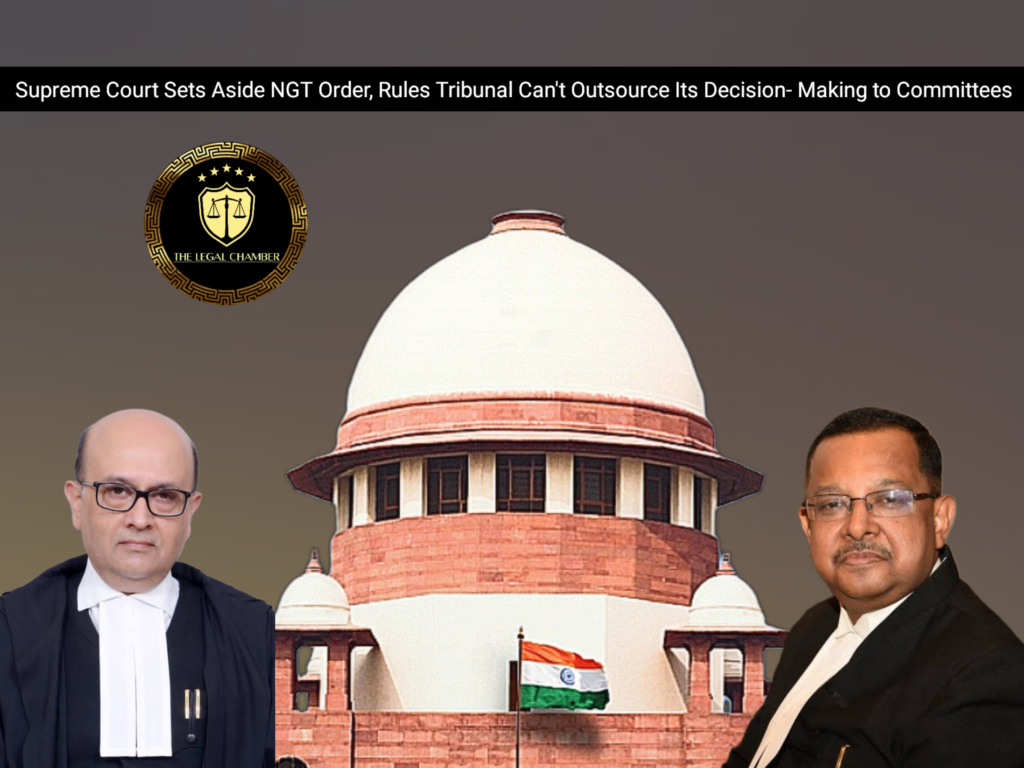
This Supreme Court judgment underscores that the National Green Tribunal must adhere to statutory procedures and principles of natural justice when passing adverse orders. The Supreme Court set aside the NGT’s orders, holding that imposing environmental compensation without making the appellant a party, providing a hearing, or following the mandatory sampling process under the Water Act, 1974, renders the decision illegal and void.
Facts Of The Case:
The case originated from a complaint filed before the National Green Tribunal (NGT) alleging that M/s Triveni Engineering and Industries Ltd. was discharging untreated effluent from its Muzaffarnagar sugar mill, contaminating the local groundwater. The NGT constituted a Joint Committee to inspect the unit. Based on the Committee’s reports, which cited violations including illegal disposal of untreated effluent, dilution of samples, and absence of mandatory records, the NGT, through impugned orders, held the appellant guilty of environmental norm violations and imposed a compensation of Rs. 18 Crores. The appellant challenged these orders before the Supreme Court, contending that the entire NGT proceeding was conducted in violation of natural justice as it was never made a party to the case, was not given notice or a hearing, and the Joint Committee’s inspection and sampling did not follow the mandatory procedure laid down under Sections 21 and 22 of the Water (Prevention and Control of Pollution) Act, 1974.
Procedural History:
The procedural history of this case began with a complaint registered as Original Application No. 71/2021 before the National Green Tribunal (NGT). The NGT constituted a Joint Committee which conducted an inspection and submitted reports. Relying on these reports, the NGT passed the impugned orders dated 15.02.2022 and 16.09.2022, holding the appellant violative of environmental norms and imposing a compensation of Rs. 18 Crores. Aggrieved by these orders, the appellant filed civil appeals before the Supreme Court under Section 22 of the NGT Act, 2010. The Supreme Court issued notice and stayed the operation of the NGT’s orders. After hearing the parties, the Supreme Court allowed the appeals and set aside the NGT’s orders, finding the entire proceeding vitiated by a violation of natural justice and statutory procedure.
READ ALSO:Supreme Court Rules :You Can’t Claim Property with Just a Will or Power of Attorney
Court Observation:
The Supreme Court made crucial observations on the legal process, holding that the National Green Tribunal’s orders were passed in complete violation of the principles of natural justice. The Court emphasized that the appellant, being the entity directly affected, was a necessary party and condemning it unheard vitiated the proceedings. It further observed that the NGT outsourced its adjudicatory function to the Joint Committee, whose report was based on a sampling procedure that did not conform to the mandatory statutory process under Sections 21 and 22 of the Water Act, 1974. The Court ruled that the NGT, while not bound by the Code of Civil Procedure, must strictly adhere to statutory procedures and the principles of natural justice when its decisions entail serious civil consequences.
Final Decision & Judgement:
The Supreme Court allowed the appeals and set aside the impugned orders of the National Green Tribunal dated 15.02.2022 and 16.09.2022. The Court declared the NGT’s orders illegal and null and void, as they were passed in complete violation of the principles of natural justice and the mandatory statutory procedure under the Water (Prevention and Control of Pollution) Act, 1974. The Court held that relegating the parties back to the NGT would serve no useful purpose due to the fundamentally flawed process. However, it clarified that the Uttar Pradesh Pollution Control Board (UPPCB) remains at liberty to conduct a fresh inspection and take subsequent remedial action against the appellant’s sugar mill, provided it strictly adheres to the due process of law.
Case Details:
Case Title: M/S Triveni Engineering And Industries Ltd.Versus The State Of Uttar Pradesh & Ors.
Citation: 2025 INSC 1060
Appeal Number: Civil Appeal Nos. 8119-8120 of 2022
Date of Judgement: September 01, 2025
Judges/Justice Name: Justice Manoj Misra and Justice Ujjal Bhuyan