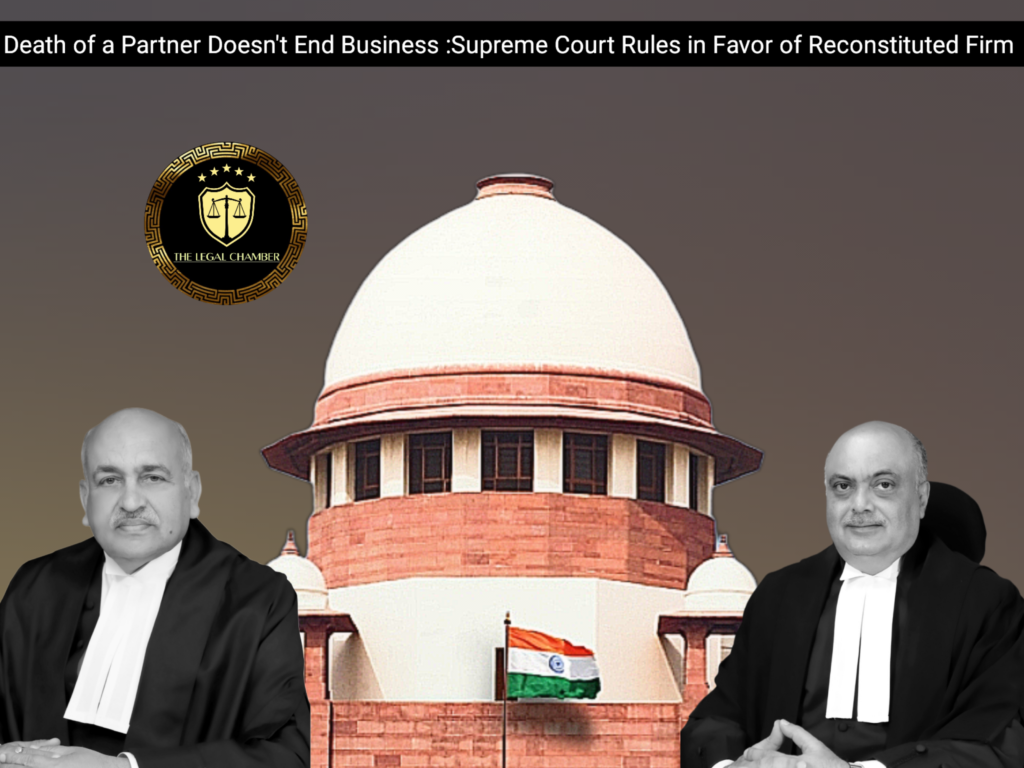
The Supreme Court upheld the Calcutta High Court’s decision, ruling that a partnership firm does not automatically dissolve upon a partner’s death if the partnership deed permits continuation with surviving partners. The Court held that Indian Oil Corporation (IOCL) could not arbitrarily stop kerosene supply without terminating the dealership agreement. It clarified that reconstitution of the firm does not require all legal heirs to join, emphasizing IOCL’s obligation to act fairly as a state instrumentality. The judgment reinforced that contractual terms and partnership deeds override rigid policy guidelines in commercial disputes.
Facts Of The Case:
The case involved a dispute between Indian Oil Corporation Limited (IOCL) and M/s Shree Niwas Ramgopal, a partnership firm operating as a kerosene distributor. The firm, originally a proprietorship of Kanhaiyalal Sonthalia, was reconstituted in 1989 as a partnership with Kanhaiyalal (55% share) and his two sons, Ramesh (35%) and Gobinda (10%). After Kanhaiyalal’s death in 2009, disputes arose among his heirs over his 55% stake, with some staking claims while others sought details of the firm’s assets. Meanwhile, the surviving partners proposed reconstituting the firm by including one heir, Bijoy Sonthalia, and submitted the required documents to IOCL. However, IOCL refused to recognize the reconstitution, citing its 2008 policy guidelines requiring all legal heirs to join or submit no-objection certificates. The firm challenged IOCL’s decision in the Calcutta High Court, which ruled in its favor, directing IOCL to continue kerosene supply until the firm was properly reconstituted. The High Court held that the partnership deed permitted continuation with surviving partners and did not mandate all heirs’ inclusion. IOCL appealed to the Supreme Court, which upheld the High Court’s decision, emphasizing that contractual terms and partnership law prevailed over IOCL’s rigid policy. The Court criticized IOCL’s arbitrary approach and affirmed the firm’s right to continue business without forcing all heirs into the partnership.
Procedural History:
The case originated when M/s Shree Niwas Ramgopal, a partnership firm, filed Writ Petition No. 758 of 2010 before the Calcutta High Court after IOCL threatened to stop kerosene supplies, citing non-compliance with its reconstitution policy following a partner’s death. The Single Judge (03.07.2012) ruled in favor of the firm, directing IOCL to maintain supplies and permit reconstitution subject to civil court decisions. Dissatisfied, IOCL appealed before the Division Bench of the Calcutta High Court, which upheld the Single Judge’s decision on 04.07.2018, citing precedent (Indian Oil Corporation vs. Roy and Company) and emphasizing IOCL’s obligation to act fairly. IOCL then filed a Special Leave Petition (Civil No. 1381 of 2025) before the Supreme Court, arguing strict adherence to its policy. The Supreme Court (14.07.2025) dismissed the petition, affirming the High Court’s rulings and holding that IOCL’s arbitrary discontinuation of supplies violated contractual and partnership law principles. The case thus progressed through three judicial tiers, with consistent findings against IOCL’s rigid interpretation of its guidelines.
READ ALSO :No Civil Suit Barrier: Supreme Court Rules Criminal Trial Must Proceed in Land Scam Case
Court Observation:
The Supreme Court made several key observations in its judgment. It noted that IOCL, as a state instrumentality, acted in a high-handed and arbitrary manner by discontinuing kerosene supply without valid grounds. The Court emphasized that the partnership deed explicitly permitted the firm to continue operations with surviving partners after a partner’s death, and this contractual provision overrode IOCL’s policy guidelines. The bench observed that Section 42 of the Partnership Act, which provides for automatic dissolution upon a partner’s death, does not apply when there are more than two partners and the partnership deed contains contrary provisions. The Court further held that IOCL’s insistence on all legal heirs joining the reconstituted firm was unreasonable, as neither the partnership deed nor the dealership agreement mandated such a requirement.Significantly, the Court criticized IOCL for adopting a hyper-technical interpretation of its guidelines that disrupted an ongoing business, noting that none of the deceased partner’s heirs had objected to the firm’s continuation. The judgment reinforced that state entities must act fairly and equitably in commercial matters, and cannot arbitrarily interfere with contractual rights. The Court ultimately found no merit in IOCL’s appeal and upheld the High Court’s directions to continue supply while allowing proper reconstitution of the firm.
Final Decision & Judgement:
The Supreme Court dismissed Indian Oil Corporation Limited’s (IOCL) Special Leave Petition and upheld the Calcutta High Court’s judgment, directing IOCL to continue kerosene supply to M/s Shree Niwas Ramgopal. The Court ruled that IOCL acted arbitrarily in stopping supplies without terminating the dealership agreement, violating principles of fairness and contractual obligations. It affirmed that the partnership firm could continue with its surviving partners under the original deed, rejecting IOCL’s argument that all legal heirs must join for reconstitution. The bench emphasized that state entities like IOCL must act reasonably in commercial matters and avoid disrupting lawful businesses. The judgment reinforced contractual autonomy and partnership rights over rigid corporate policies, ensuring business continuity while protecting dealers from arbitrary state action. No costs were awarded, but the Court cautioned IOCL against similar unjust disruptions in future dealings.
Case Details:
Case Title: Indian Oil Corporation Limited & Ors. vs. M/s Shree Niwas Ramgopal & Ors.
Citation: 2025 INSC 832
Appeal No.: Special Leave Petition (Civil) No. 1381 of 2025
Date of Judgment: July 14, 2025
Bench: Justice Pankaj Mithal  & Justice Ahsanuddin Amanullah
Download The Judgement Here