
Tag: Statutory Interpretation

Supreme Court Upholds National Fraternity: Teaching Experience Across India Counts
Supreme Court

Supreme Court Upholds National Fraternity: Teaching Experience Across India Counts

The Supreme Court held that a government notification extending the retirement age must be interpreted purposively, and a condition requiring "10 years of teaching experience in any State-aided university" includes experience from universities outside the state. Excluding such experience was found to be an arbitrary and discriminatory classification violating the right to equality under Article 14. Facts Of The Case: The appellant was initially appointed as a teacher in a government college in Assam in 1991, where he served for 16 years. In 2007, he was selected for a non-teaching post at Burdwan University, West Bengal, based on his qualifications and experience, and was later promoted in 2012. In 2021, the State of West Bengal issued a notification increasing the retirement age from 60...
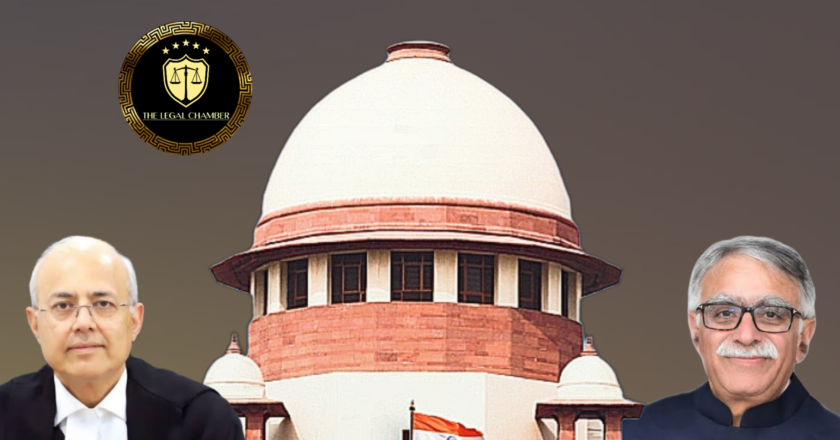
Supreme Court Strikes Down Kerala’s Preventive Detention Order: A Win for Personal Liberty
Supreme Court

Supreme Court Strikes Down Kerala’s Preventive Detention Order: A Win for Personal Liberty

The Supreme Court of India, in Dhanyam v. State of Kerala & Ors., set aside a preventive detention order, emphasizing that such extraordinary power must be used sparingly and only in situations affecting "public order," not merely "law and order". The Court reiterated that if a detenu is on bail and allegedly violating conditions, the State should seek bail cancellation rather than resorting to preventive detention. Facts Of The Case: The appeal originated from a High Court of Kerala judgment dated September 4, 2024, which affirmed a preventive detention order issued on June 20, 2024, by the District Magistrate, Palakkad. The detenu, Rajesh, the appellant's husband, runs a registered lending firm named 'Rithika Finance'. The detention order, issued under Section 3(1) of the Kerala ...
Supreme Court : From Life Imprisonment to 20 Years Young Offenders Get Relief in POCSO Case
Supreme Court

Supreme Court : From Life Imprisonment to 20 Years Young Offenders Get Relief in POCSO Case

The Supreme Court of India granted leave to appeal against a High Court judgment dated April 26, 2024, which affirmed the conviction of appellants under various sections of the IPC and Section 6 of the POCSO Act, 2012, including imprisonment for life. While upholding the conviction, the Supreme Court partially allowed the appeals, reducing the sentence from life imprisonment (remainder of natural life) to twenty years of rigorous imprisonment based on Section 6 of the POCSO Act and considering the appellants' age and incarceration period. Facts Of The Case: Pintu Thakur @ Ravi and other appellants were convicted by the Additional Sessions Judge, Fast Track Special Court (POCSO Act), Ramanujganj, District Balrampur, in Special Sessions (POCSO) Case No. 36/2020. This conviction was subse...
Supreme Court Rules Customs Duty Drawback Circular Has Retrospective Effect
Supreme Court

Supreme Court Rules Customs Duty Drawback Circular Has Retrospective Effect

The Supreme Court held that Circular No. 35/2010-Cus. dated 17.09.2010, which clarified the entitlement of merchant exporters to claim 1% All Industry Rate (AIR) customs duty drawback irrespective of availing CENVAT benefits, was clarificatory and declaratory in nature. Consequently, the Court ruled that the Circular must be applied retrospectively, ensuring uniform benefits from 2008 onwards. The judgment emphasized that clarificatory circulars, which resolve ambiguities in existing notifications without creating new rights, operate retrospectively to align with the legislative intent. The High Court's order denying retrospective application was set aside. Facts Of The Case: The appellant, M/s Suraj Impex (India) Pvt. Ltd., a merchant exporter of Soyabean Meal (SBM), claimed All Industr...