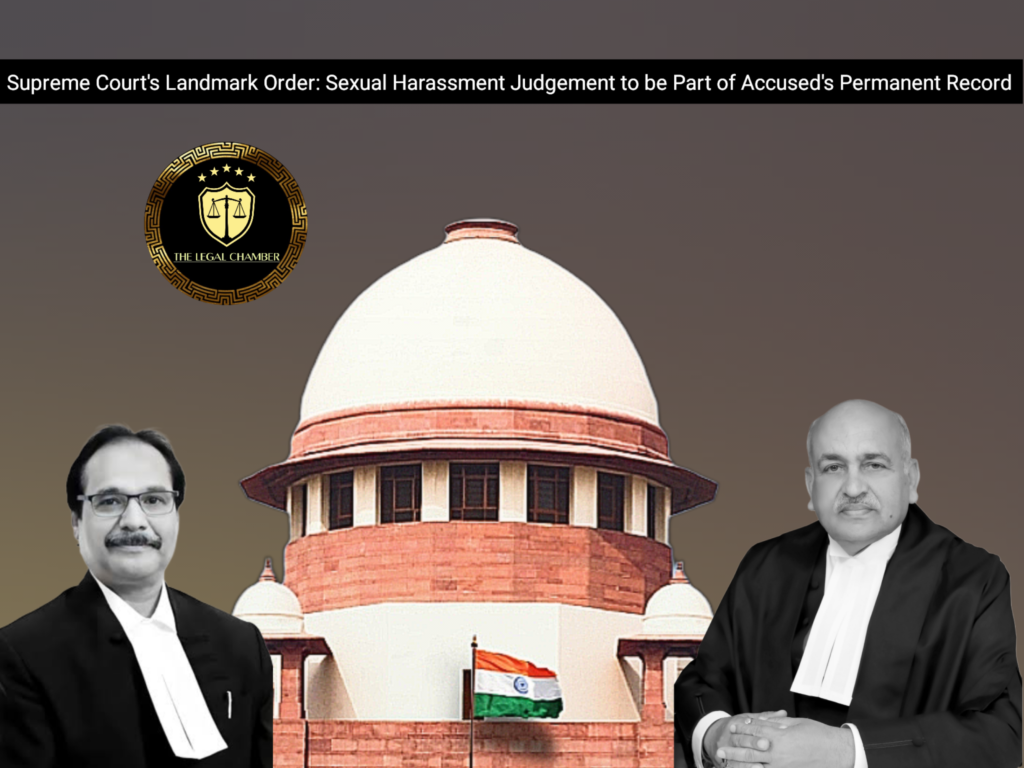
This Supreme Court ruling clarifies that under the POSH Act, a complaint must be filed within three months (extendable to six) of the last incident of sexual harassment. Subsequent administrative actions, unless directly linked to the original misconduct as a “continuing wrong,” do not extend this limitation period. The Court distinguished between a “continuing wrong” and a “recurring wrong,” holding that independent administrative decisions do not constitute a fresh act of sexual harassment.
Facts Of The Case:
The case involves Dr. Nirmal Kanti Chakrabarti, the Vice-Chancellor of NUJS, Kolkata, and Ms. Vaneeta Patnaik, a faculty member. The appellant, Ms. Patnaik, lodged a formal complaint of sexual harassment against the Vice-Chancellor with the Local Complaint Committee (LCC) on December 26, 2023. Her complaint detailed several alleged incidents, beginning in 2019 with unwanted advances, demands for sexual favours, and threats against her career. The last alleged incident of outright sexual harassment occurred in April 2023, when the Vice-Chancellor allegedly asked her to accompany him on a trip and threatened her career upon refusal. Subsequently, in August 2023, the appellant was removed from her additional post as Director of a centre, and an inquiry was initiated against her concerning project funds based on a complaint from an external body. The LCC rejected her sexual harassment complaint as being barred by the limitation period prescribed under the POSH Act, as it was filed more than three months after the April 2023 incident. A Single Judge of the High Court overturned this decision, but a Division Bench later restored the LCC’s order, leading to the present appeal before the Supreme Court, which centered on whether the subsequent administrative actions constituted a continuation of the harassment for calculating the limitation period.
Procedural History:
The procedural history of this case commenced with the appellant filing a complaint before the Local Complaint Committee (LCC) on December 26, 2023. The LCC rejected the complaint as being barred by the limitation period prescribed under the POSH Act. Aggrieved by this, the appellant filed a writ petition before the High Court, where a Single Judge quashed the LCC’s order and directed a fresh hearing on the merits. This decision was challenged by the respondent before a Division Bench of the High Court via a writ appeal. The Division Bench allowed the appeal, setting aside the Single Judge’s order and thereby restoring the LCC’s original decision to dismiss the complaint as time-barred. The appellant then approached the Supreme Court under its special leave jurisdiction, which granted leave and culminated in the present appeal and the final judgment.
READ ALSO :Homebuyer Alert: Supreme Court Clarifies When a Real Estate Investment Becomes “Speculative”
Court Observation:
In its observations, the Supreme Court meticulously analyzed the definition of sexual harassment under the POSH Act. The Court noted that while Section 3(2) includes acts like creating a hostile work environment, there must be a direct nexus to the original acts of sexual misconduct. It drew a critical distinction between a “continuing wrong,” where the injury itself persists, and a “recurring wrong,” where a fresh cause of action arises. The Court observed that the alleged sexual harassment ended in April 2023, and the subsequent administrative actions in August 2023, being collective decisions of the Executive Council based on independent complaints, were not a continuation of the sexual harassment but independent, gender-neutral administrative measures. Consequently, these later events did not extend the limitation period, making the complaint filed in December 2023 time-barred. Despite dismissing the appeal on this technical ground, the Court issued a unique directive for the judgment to be made a part of the respondent’s permanent record.
Final Decision & Judgement:
The Supreme Court dismissed the appeal, upholding the Division Bench’s decision that the complaint was time-barred. The Court concluded that the last incident of sexual harassment occurred in April 2023, and the subsequent administrative actions against the appellant in August 2023 were independent, collective decisions with no direct link to the earlier acts of sexual misconduct. Therefore, these later events did not constitute a “continuing wrong” that would extend the limitation period under the POSH Act. As the complaint was filed on December 26, 2023, it was beyond the maximum permissible period of six months from the last incident. However, in a significant concluding directive, the Court ordered that this judgment be made a permanent part of the respondent’s resume, ensuring the allegations would remain on his professional record.
Case Details:
Case Title: Vaneeta Patnaik vs Nirmal Kanti Chakrabarti & Ors.
Citation: 2025 INSC 1106
Civil Appeal No:  (Arising out of Special Leave Petition (C) No. 17936 of 2025)
Date of Judgement: September 12, 2025
Judges/Justice Name: Justice Pankaj Mithal and Justice Prasanna B. Varale
Download The Judgement Here