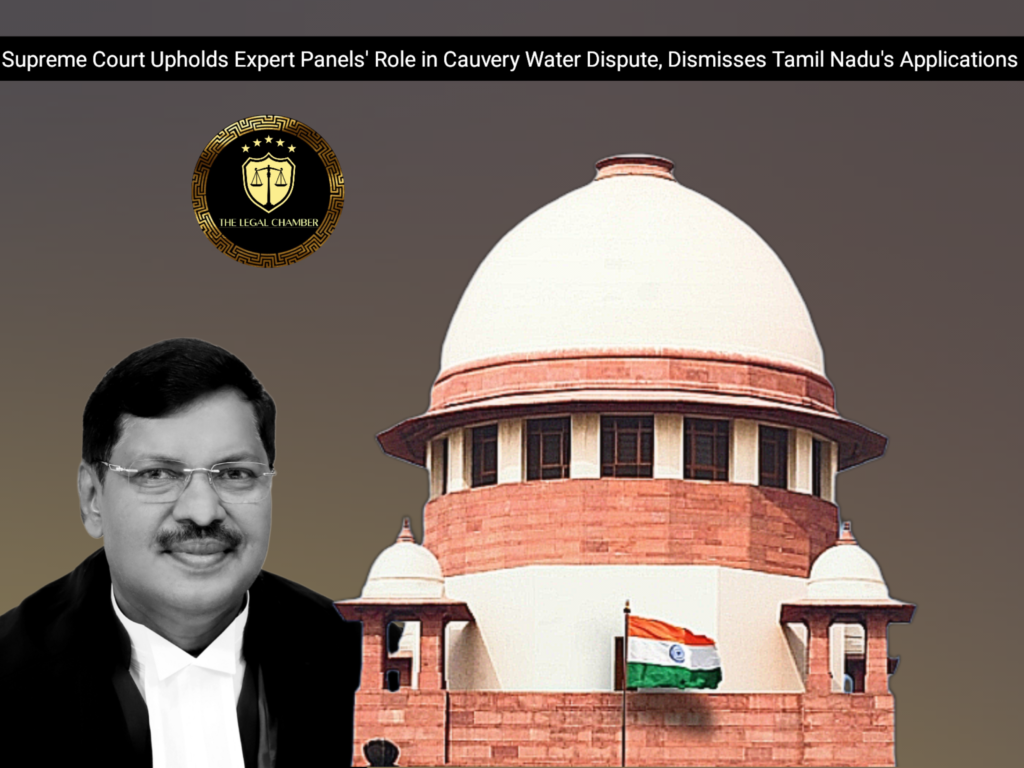
The Supreme Court declined to intervene, emphasizing the principle of judicial restraint in matters requiring technical expertise. It held that statutory expert bodies like the CWMA and CWRC are the appropriate fora to adjudicate disputes concerning water allocation and project approval under the final decree, and parties must exhaust these remedies first.
Facts Of The Case:
The case concerns the long-standing Cauvery river water dispute between the State of Tamil Nadu and the State of Karnataka. The core issue arose when Tamil Nadu filed Miscellaneous Application No. 3127 of 2018 in the Supreme Court, seeking to stall Karnataka’s proposed Mekedatu Balancing Reservoir cum Drinking Water Project. Tamil Nadu argued that the Central Water Commission’s (CWC) permission for Karnataka to prepare a Detailed Project Report (DPR) for the dam was illegal, as it would impede the “uncontrolled flow” of water to which Tamil Nadu was entitled under the final decree of the Cauvery Water Disputes Tribunal, as modified by the Supreme Court in February 2018. Karnataka countered that the project was merely for utilizing its allocated share of water and would not affect downstream releases. In a related application (M.A. No. 1869 of 2023), Tamil Nadu also alleged that Karnataka was not returning treated water to the Cauvery basin from Bangalore’s drinking water supply, as required. The Supreme Court consolidated these matters with a Contempt Petition and a Writ Petition, all stemming from the implementation of its 2018 final award on water sharing.
Procedural History:
The procedural history of this case is rooted in the final adjudication of the Cauvery water dispute by the Supreme Court in February 2018. Following this judgment, the Union of India constituted the Cauvery Water Management Authority (CWMA) and Cauvery Water Regulatory Committee (CWRC) for implementation. The present litigation commenced when Tamil Nadu filed Miscellaneous Application No. 3127 of 2018, challenging the CWC’s permission for Karnataka to prepare a Detailed Project Report for the Mekedatu dam. Subsequently, Tamil Nadu filed additional applications, including M.A. No. 1869 of 2023 concerning the return of treated water, and a Contempt Petition. A separate Writ Petition was also filed in the public interest. All these interconnected applications and petitions, tagged with the original Civil Appeal number, were heard together and disposed of by a common judgment in November 2025.
READ ALSO:No Medical Injury? No Problem: Supreme Court Explains When Victim’s Word Wins in POCSO Cases
Court Observation:
The Supreme Court made key observations centered on the principle of judicial restraint in technical domains. It noted that the court itself lacks the specialized expertise required to adjudicate on complex water management and infrastructure projects. The Court emphasized that statutory expert bodies like the Cauvery Water Management Authority (CWMA) and the Cauvery Water Regulatory Committee (CWRC) are specifically constituted for this purpose and are the primary fora for resolving such implementation disputes. It held that Karnataka’s actions, at the current stage, were merely preparatory and subject to multiple layers of expert scrutiny by the CWMA, CWRC, and Central Water Commission. The Court clarified that every state has the right to utilize its allocated water share optimally, provided it does not diminish the quota of other states, and that the expert bodies are tasked with ensuring this balance. Consequently, it found the applications premature and directed the parties to seek remedies before the designated expert authorities.
Final Decision & Judgement:
The Supreme Court, in its final judgment, rejected Tamil Nadu’s Miscellaneous Application No. 3127 of 2018 and disposed of all connected applications. It held that the challenge to the Mekedatu project was premature, as the permission granted was only for preparing a Detailed Project Report (DPR), which would subsequently require rigorous approval from expert bodies like the CWMA and CWRC. The Court refused to intervene on the merits, reiterating the principle of judicial restraint and deference to specialized statutory authorities in technical matters of water allocation and project approval. It directed Tamil Nadu to raise any grievances regarding compliance or implementation before the CWMA and CWRC, affirming these bodies as the appropriate and primary mechanism for enforcing the final decree on Cauvery water sharing.
Case Details:
Case Title:The State of Karnataka by its Chief Secretary vs.State of Tamil Nadu by its Chief Secretary & Others
Citation: 2025 INSC 1343
Civil Appeal No.: Civil Appeal No. 2453 of 2007
Date of Judgement: November 13, 2025
Judges/Justice Name: B.R. Gavai