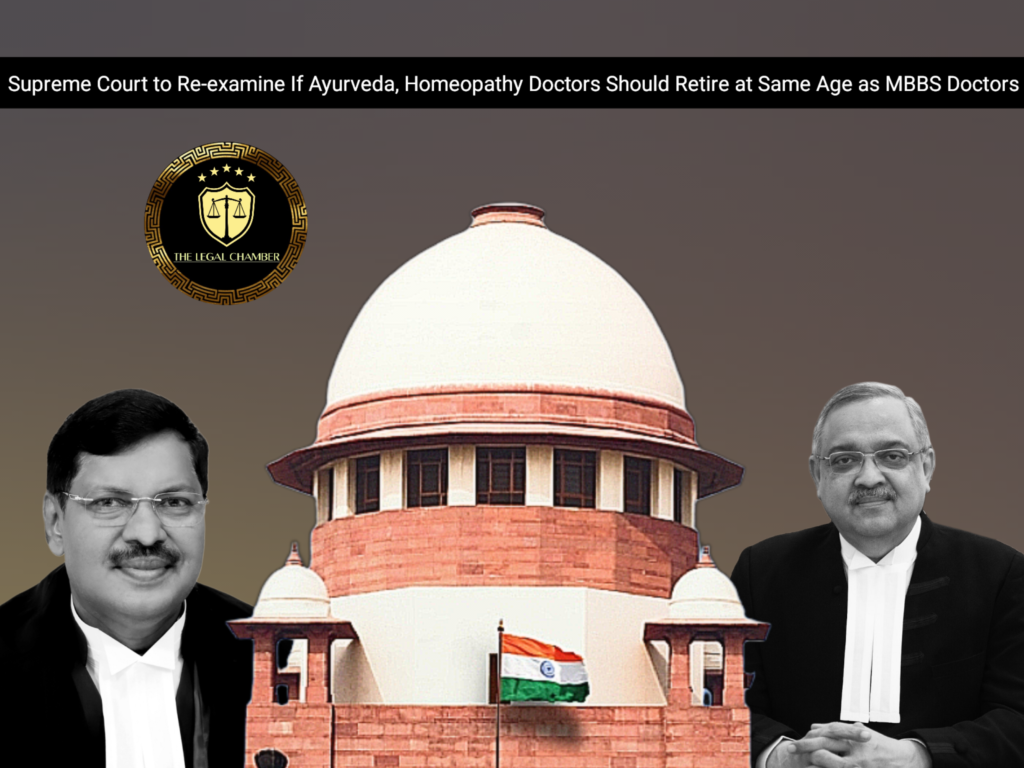
The Supreme Court has referred to a larger bench the question of whether MBBS (allopathic) and AYUSH (indigenous system) doctors can be treated equally for service conditions like retirement age and pay. The Court noted divergent precedents on whether classification based on educational qualification and differing job functions violates Articles 14 and 16 of the Constitution.
Facts Of The Case:
The case involves a batch of Special Leave Petitions concerning the service conditions of doctors, specifically whether practitioners of allopathy (MBBS doctors) and those of indigenous systems like Ayurveda, Homeopathy, and Unani (AYUSH doctors) can be treated equally, particularly regarding retirement age. The legal dispute stems from varying retirement ages set by different states for these two categories of doctors. The petitioners, including the State of Rajasthan, argued that the distinction is based on valid classification due to differences in qualifications, nature of work, and public interest in retaining critical allopathic care.The Court examined conflicting precedents. In Dr. Ram Naresh Sharma, it was held that denying AYUSH doctors an enhanced retirement age was discriminatory, as they provide the same service. However, in Dr. P.A. Bhatt, the Court ruled that classification based on educational qualification is valid under Articles 14 and 16, emphasizing that MBBS doctors perform critical, emergency, and surgical duties not undertaken by AYUSH practitioners. Faced with this divergence on the principles of “equal pay for equal work” and the permissibility of classification, the Supreme Court found the issue required an authoritative pronouncement. Consequently, it referred the matter to a larger Constitution Bench for final determination.
Procedural History:
The procedural history of this case involves a series of appeals originating from decisions by various High Courts and administrative tribunals concerning the service conditions of doctors. Multiple Special Leave Petitions (SLPs) were filed before the Supreme Court of India, challenging orders that dealt with the parity in retirement age and pay scales between allopathic (MBBS) and AYUSH doctors. These petitions were clubbed together for a consolidated hearing due to the common substantial question of law involved. A Division Bench of the Supreme Court, after hearing arguments and reviewing conflicting judgments from its own bench in earlier cases like Dr. Ram Naresh Sharma and Dr. P.A. Bhatt, concluded that the legal issue required resolution by a larger bench to provide an authoritative precedent. Consequently, the court did not decide the merits but exercised its referral power, directing the Registry to place the matter before the Chief Justice of India for constitution of an appropriate larger bench.
READ ALSO:Supreme Court Protects Religious Freedom: Quashes Multiple UP Conversion FIRs
Court Observation:
The Supreme Court made several key observations in its referral order. It acknowledged the conflicting precedents, noting that while Dr. Ram Naresh Sharma emphasized equal service for patients, Dr. P.A. Bhatt established a fundamental distinction based on qualifications and nature of duties. The Court observed that the principle of “equal work for equal pay” requires examining the identity of functions, similarity in work, and comparable duties. It found that MBBS doctors perform critical, life-saving, emergency, and surgical procedures not undertaken by AYUSH practitioners, and that public footfall in allopathic institutions is significantly higher. The Court also noted the states’ argument that differentiating retirement age addresses a genuine public interest in retaining sufficient allopathic doctors. These factors, the Court suggested, could justify treating the two categories as separate classes for service conditions, provided such classification has a reasonable nexus to a legitimate state objective. Due to the unresolved legal ambiguity, the Court deemed an authoritative pronouncement necessary.
Final Decision & Judgement:
The Supreme Court did not render a final judgment on the merits of the case. Instead, recognizing a clear divergence in its own earlier rulings on whether allopathy (MBBS) and AYUSH doctors can be treated equally for service conditions like retirement age and pay, the Court referred the substantial question of law to a larger Constitution Bench for an authoritative pronouncement. As an interim measure, it permitted state authorities to continue AYUSH doctors in service until the higher retirement age fixed for MBBS doctors, but without regular pay and allowances. They would instead receive half pay, which would later be adjusted against their pension or final dues based on the larger bench’s ultimate decision. The Registry was directed to place the matter before the Chief Justice of India for appropriate directions.
Case Details:
Case Title: State of Rajasthan and Ors. vs. Anisur Rahman
Appeal Number: Special Leave Petition (Civil) No. 9563 of 2024
Date of Judgement: October 17, 2025
Judges/Justice Name: Justice B. R. Gavai & Justice K. Vinod Chandran
Download The Judgement Here