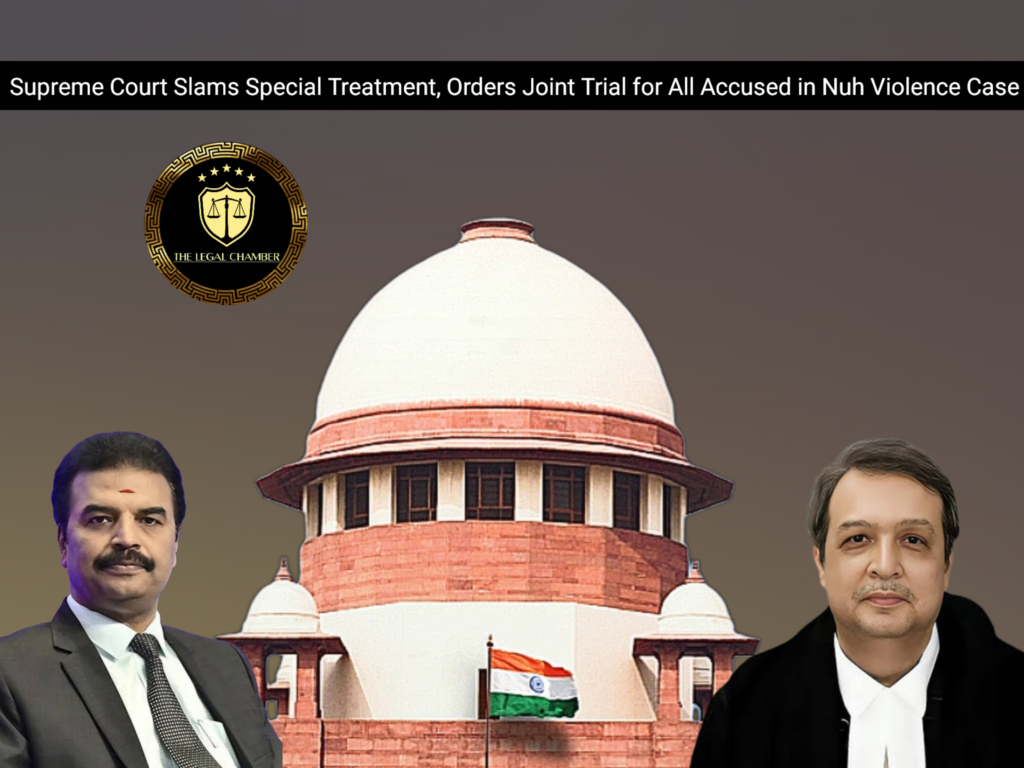
The Supreme Court held that segregating the trial of an accused solely based on their status as an MLA is legally unsustainable. Such an order violates the statutory scheme for joint trials under Sections 218-223 CrPC when offences arise from the same transaction and common evidence. It also infringes upon the fundamental rights to equality under Article 14 and a fair trial under Article 21 of the Constitution. The direction for a separate charge sheet was also quashed as it exceeds the court’s jurisdiction.
Facts Of The Case:
The case originated from two FIRs (Nos. 149 and 150 of 2023) registered at Police Station Nagina, District Nuh, concerning large-scale communal violence that occurred on July 31, 2023. The appellant, Mamman Khan, a sitting Member of the Legislative Assembly (MLA) from Haryana, was arrayed as an accused in both FIRs, which alleged offences including rioting, dacoity, and criminal conspiracy. The prosecution’s case was based on an overarching conspiracy involving all accused, supported by common evidence like call records and witness statements. Initially, joint proceedings were commenced. However, the trial court, via orders dated August 28 and September 2, 2024, directed the police to file a separate charge sheet against the appellant and segregated his trial from the co-accused. The court cited repeated non-appearance of some co-accused causing delay and the appellant’s status as an MLA, invoking the Supreme Court’s directions for expeditious trials of legislators. The High Court upheld this segregation. The appellant then approached the Supreme Court, challenging the segregation as arbitrary and a violation of procedural and constitutional rights.
Procedural History:
The procedural history of this case commenced with the trial court’s orders dated 28.08.2024 and 02.09.2024, which directed the filing of a separate charge sheet against the appellant, Mamman Khan, and segregated his trial from that of the co-accused. Challenging this segregation, the appellant filed petitions under Section 482 of the CrPC before the High Court of Punjab and Haryana. The High Court, vide its common judgment dated 12.12.2024, dismissed these petitions and upheld the trial court’s orders. Aggrieved by the High Court’s decision, the appellant approached the Supreme Court by way of Special Leave Petitions. The Supreme Court granted leave and, after hearing the parties, set aside the impugned orders of the High Court and the trial court, quashing the segregation and remanding the matter for a joint trial.
READ ALSO:Supreme Court :You Can’t Escape a Murder Charge Just Because the Victim Lived for Months
Court Observation:
The Supreme Court made several critical observations while setting aside the segregation of the trial. It held that the trial court’s order, based solely on the appellant’s status as an MLA to ensure a speedy trial, was legally unsustainable. The Court emphasized that the statutory scheme under Sections 218-223 of the CrPC mandates a joint trial for offences arising from the same transaction, supported by common evidence, as was the case here. It observed that the directions in Ashwini Kumar Upadhyay for expeditious disposal of cases against legislators do not authorize a deviation from these mandatory legal norms or grant a procedural disadvantage to an accused. The Court further found that the suo motu segregation order, passed without notice or a meaningful hearing, violated the principles of natural justice and the appellant’s fundamental right to a fair trial under Article 21. It also ruled that the appellant’s political office cannot justify arbitrary classification, underscoring the guarantee of equality before law under Article 14. The act of directing the police to file a separate charge sheet was also deemed an exceeding of the trial court’s jurisdiction.
Final Decision & Judgement:
The Supreme Court allowed the appeals and set aside the impugned orders of the High Court and the trial court. The Court quashed the direction to file a separate charge sheet against the appellant and the consequential segregation of his trial from that of the co-accused. The matter was remitted to the trial court with a direction to conduct a joint trial of the appellant along with the co-accused, in accordance with the law. The trial court was given the liberty to regulate the proceedings to ensure an expeditious disposal, but with the explicit stipulation that it must do so without compromising procedural safeguards and only after providing a hearing to all concerned parties.
Case Details:
Case Title: Mamman Khan vs State of Haryana
Citation: 2025 INSC 1113
Criminal Appeal No.: Criminal Appeal Nos. 4002 and 4003 of 2025
Date of Judgement: September 12, 2025
Judges/Justice Name: Justice R. Mahadevan and Justice J. B. Pardiwala
Download The Judgement Here