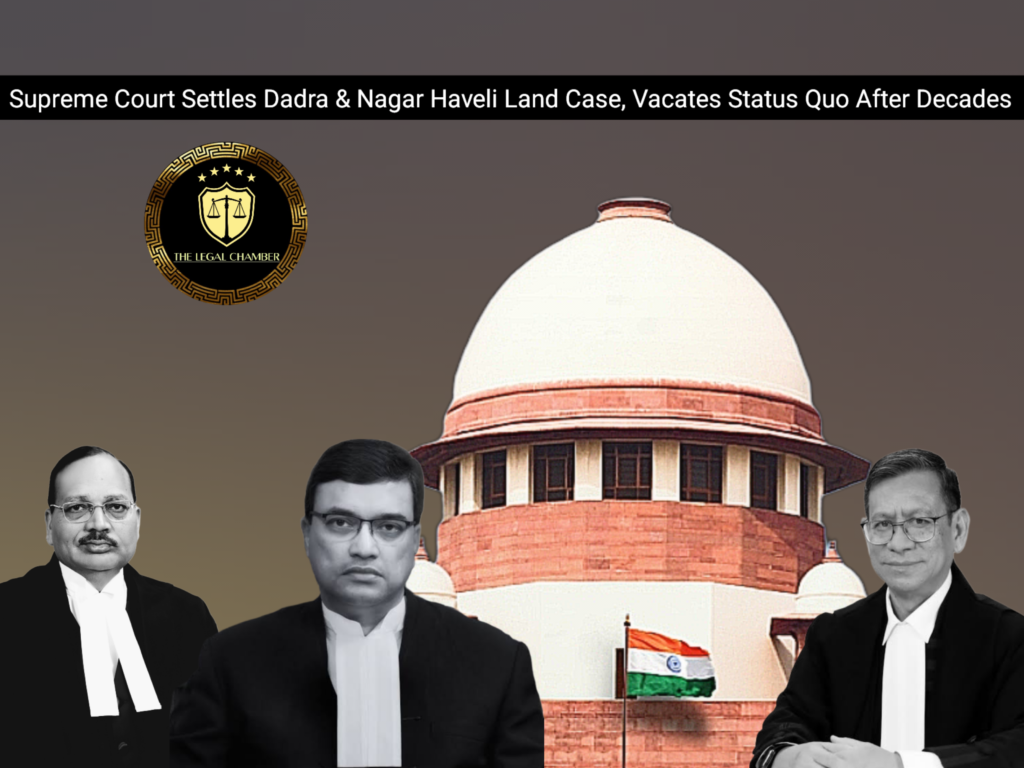
Facts Of The Case:
The case concerns land in Dadra and Nagar Haveli, originally granted by the Portuguese government between 1923 and 1930 under contracts known as ‘Alvaras’. These grants, based on the legal principle of ‘emphyteusis’, gave the holders inheritable and transferable rights subject to the mandatory condition of bringing the land under agricultural cultivation, as stipulated in Article 12 of the Organic Structure of the Lands of Nagar Haveli (OA). After the territory’s liberation and integration into India, the Collector, in 1974, rescinded these grants, citing a failure to cultivate the lands as required. The landowners challenged this, arguing the state had waived its rights through decades of inaction and that the land was uncultivable. The Trial Court and First Appellate Court ruled in the landowners’ favor, accepting their pleas of waiver and acquiescence. However, the High Court reversed these decisions in second appeal. The landowners then appealed to the Supreme Court, which was tasked with determining the validity of the rescission and the applicability of the doctrines of waiver and acquiescence against the state.
Procedural History:
The procedural history of this case began with the landowners filing a civil suit in 1974 challenging the Collector’s order that rescinded their land grants. Both the Trial Court (1978) and the First Appellate Court (1983) ruled in favor of the landowners, accepting their pleas of waiver and acquiescence by the state. The respondents (Union of India) then filed second appeals before the High Court. In 2005, the High Court allowed these appeals, setting aside the lower courts’ judgments and upholding the Collector’s order of rescission. The aggrieved landowners subsequently appealed to the Supreme Court, which issued a status quo order in 2005. After a prolonged legal process, the Supreme Court finally delivered its judgment in 2025, dismissing the landowners’ appeals and affirming the High Court’s decision.
READ ALSO:“Pay and Recover” Doctrine Upheld: Supreme Court Directs Insurance to Compensate, Then Claim from Owner
Court Observation:
The Supreme Court made several key observations. It held that the mandatory conditions for cultivation under the Portuguese-era agrarian law were rooted in public interest and could not be waived, condoned, or defeated by the state’s mere inaction or delay. The Court emphasized that the doctrine of waiver does not apply to statutory obligations grounded in public policy. It further refused to entertain new legal grounds raised for the first time at the Supreme Court level, confining its analysis to the original pleadings. The Bench also found that the Collector’s order of rescission was neither arbitrary nor mala fide, as it was based on a proper inquiry and complied with the principles of natural justice as directed by the High Court. Ultimately, the Court affirmed that the state retains the right to enforce such conditions, regardless of the passage of time.
Final Decision & Judgement:
The Supreme Court dismissed the appeals and upheld the High Court’s judgment. It ruled that the Collector’s 1974 order, which rescinded the land grants for breach of mandatory cultivation conditions, was valid and legal. The Court rejected all contentions of waiver, acquiescence, and arbitrariness, stating that public policy conditions cannot be deemed waived by state inaction. The earlier status quo order was vacated, finalizing the land’s reversion to the government. However, the Court granted the appellants liberty to apply for occupancy rights under the 1971 Land Reforms Regulation within six weeks, directing the Collector to consider such applications on merits notwithstanding the long delay.
Case Details:
Case Title: Divyangnakumari Harisinh Parmar (Dead) and others vs. Union of India and others
Citation: 2025 INSC 1145
Appeal Number: Civil Appeal No. 1479 of 2006
Date of Judgement: September 24, 2025
Judges/Justice Name:  Justice Surya Kant,&  Justice Dipankar Datta, and  Justice Nongmeikapam Kotiswar Singh