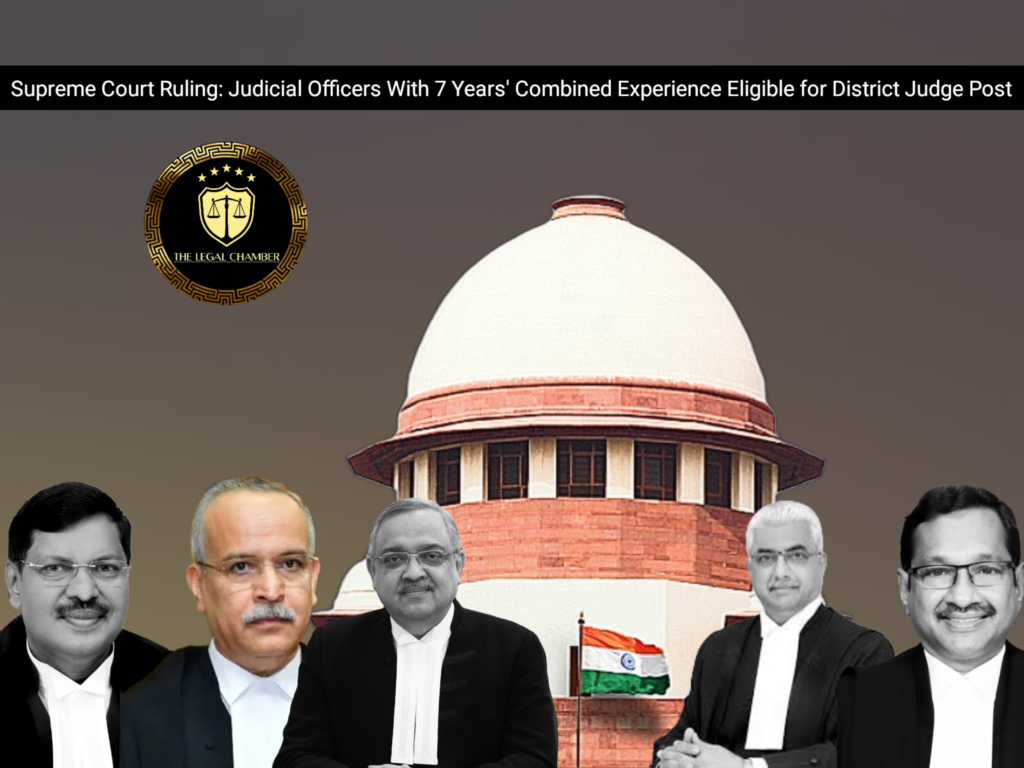
This Supreme Court Constitution Bench judgment reinterpreted Article 233(2) of the Constitution. It held that judicial officers are not barred from applying for the post of District Judge through direct recruitment. The Court clarified that the seven-year practice requirement under Article 233(2) applies only to candidates not already in judicial service, thereby overruling contrary precedents like Dheeraj Mor.
Facts Of The Case:
Procedural History:
The procedural history of this case is rooted in a series of interconnected petitions and appeals concerning the appointment of District Judges. The central legal controversy was referred to a three-judge bench of the Supreme Court, which, recognizing the substantial constitutional questions involved, directed the matter to be placed before a Constitution Bench. The Constitution Bench formally framed specific questions regarding the interpretation of Article 233, particularly examining whether judicial officers could compete in direct recruitment. After extensive hearings involving multiple senior counsels representing various petitioners, respondents, and intervenors, the Constitution Bench delivered its landmark judgment, overruling the prior precedent set in Dheeraj Mor v. High Court of Delhi and clarifying the legal position on the eligibility of in-service candidates.
READ ALSO:Supreme Court Denies Specific Performance for Deal Breaching Construction Laws
Court Observation:
In its detailed observations, the Constitution Bench held that Article 233 creates two distinct sources for appointing District Judges: those already in the judicial service, and advocates/pleaders. Critically, the Court ruled that the seven-year practice requirement under clause (2) applies only to candidates from the Bar, and no such eligibility is prescribed for those already in judicial service. The Bench emphasized that a contrary interpretation would render the phrase “a person not already in the service” in Article 233(2) redundant. It further found that excluding meritorious judicial officers from direct recruitment was unreasonable, violated the principles of equality, and was inconsistent with the broader constitutional scheme aiming for an efficient judiciary. Consequently, the Court overruled its earlier judgments in Satya Narain Singh and Dheeraj Mor, which had created an impermissible “quota” for advocates.
Final Decision & Judgement:
The Supreme Court allowed the appeals and petitions, setting aside the contrary view established in Dheeraj Mor. The Court held that judicial officers are eligible to compete for the post of District Judge through direct recruitment. It clarified that for in-service candidates, the eligibility shall be a combined experience of seven years as an advocate and a judicial officer. To ensure a level playing field, the Court directed that the minimum age for application for both streams be 35 years. It further mandated that all State Governments, in consultation with their respective High Courts, must frame or amend their recruitment rules in accordance with this judgment within three months, thereby quashing any existing rules that barred judicial officers from this process.
Case Details:
Case Title: Rejanish K.V. vs. K. Deepa and Others
Citation:  2025 INSC 1208
Appeal Number: Civil Appeal No. 3947 of 2020
Date of Judgment: October 09, 2025.
Judges/Justices: Justice B.R. Gavai & Justice Aravind Kumar & Justice Satish Chandra Sharma & Justice K. Vinod Chandran & Justice M.M. Sundresh
Download The Judgement Here