Facts Of The Case:
HDFC Bank filed an application under Section 7 of the Insolvency and Bankruptcy Code, 2016, against Livein Aqua Solutions Pvt. Ltd. for a defaulted loan of ₹5.5 crores. The application, verified on July 26, 2023, was supported by an affidavit deposed on July 17, 2023. The NCLT Ahmedabad Bench rejected the petition at the threshold, citing this date discrepancy in the affidavit as a fatal defect. HDFC Bank appealed to the NCLAT, which overturned the NCLT’s order, holding the defect was curable and that the NCLT had failed to issue a mandatory notice under Section 7(5)(b) of the IBC to rectify the flaw. Livein Aqua Solutions then appealed to the Supreme Court, arguing the application was fundamentally invalid. The Supreme Court dismissed the appeal, ruling that a defective affidavit is a procedural irregularity that can be cured. It underscored that the NCLT’s general notice for defects under its internal rules did not satisfy the specific mandatory requirement of a notice to the applicant under the IBC’s substantive provision. The Court restored the application, directing HDFC Bank to cure the defect within seven days for the NCLT to hear the matter on merits.
Procedural History:
The procedural history of this case began with HDFC Bank filing a Section 7 IBC application against Livein Aqua Solutions before the NCLT Ahmedabad Bench. The NCLT Registry flagged defects, including a discrepancy in the affidavit dates. After a consolidated notice under its own rules and non-compliance, the NCLT Joint Registrar refused to register the application. HDFC Bank successfully appealed this refusal within the NCLT. Subsequently, the NCLT, in its judicial capacity, rejected the main insolvency petition on the ground of the defective affidavit. HDFC Bank then appealed to the NCLAT, which set aside the NCLT’s rejection, holding the defect was curable and that the mandatory notice under Section 7(5)(b) of the IBC was not issued. This led to Livein Aqua Solutions’ final appeal to the Supreme Court, which upheld the NCLAT’s decision on the curable nature of the defect but directed the affidavit to be formally cured before the NCLT proceeds on merits.
READ ALSO:Supreme Court Balances Fairness & Flexibility in Govt. Contracts, Upholds Cancellation of LoI in Himachal Case
Court Observation:
The Supreme Court made pivotal observations on the interplay between procedural technicalities and substantive justice under the IBC. It held that a defective affidavit supporting a Section 7 application is a curable procedural irregularity and does not render the application non-est or invalid from its inception. Crucially, the Court emphasized that the mandatory notice requirement under the proviso to Section 7(5)(b) of the IBC is a substantive safeguard for the applicant. It ruled that a general defect notice issued by the NCLT Registry under its internal rules cannot substitute the specific, applicant-directed notice mandated by the IBC itself. The judgment reinforced that procedural rules are handmaidens of justice and should not be used oppressively to defeat substantive rights, especially when defects are remediable.
Final Decision & Judgement:
Case Details:
Case Title:Livein Aqua Solutions Private Limited vs. HDFC Bank Limited
Citation:2025 INSC 1349
Appeal Number:Civil Appeal No. 11766 of 2025
Date of Judgement:November 24, 2025
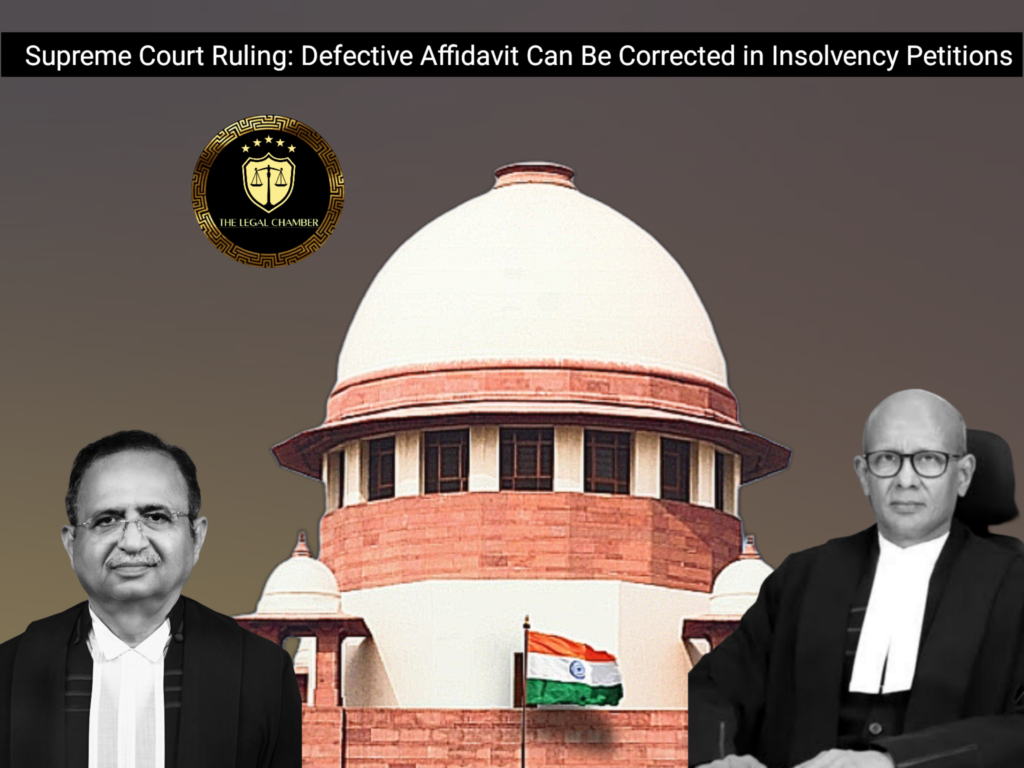
Judges/Justice Name:Justice Sanjay Kumar & Justice Alok Aradhe