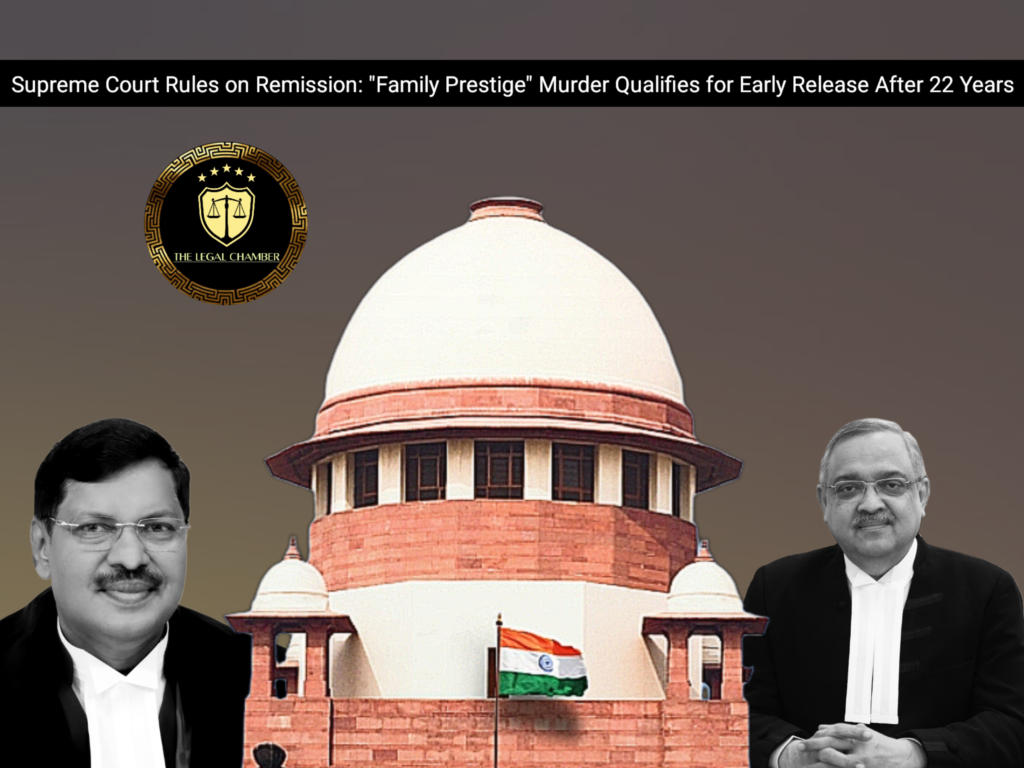
The Supreme Court allowed a life convict’s appeal for premature release, interpreting the 2010 remission guidelines. The Court held the offence, motivated by perceived family prestige, fell under Category 3(b) requiring 22 years of incarceration, not Category 4(d) requiring 24 years, and ordered the appellant’s immediate release.
Facts Of The Case:
The appellant, Anilkumar, along with a co-accused, was convicted for the premeditated murder of a man and the attempted murder of his friend. The prosecution’s case was that the attack was motivated by the fact that the deceased was in a romantic relationship with the appellant’s sister. The appellant perceived this relationship as spoiling his sister’s life and tarnishing the family’s prestige. Following his conviction, the appellant was sentenced to life imprisonment under Section 302 of the Indian Penal Code and a concurrent seven-year term under Section 307. After serving approximately 20 years and 7 months of his sentence, the appellant applied for premature release. The State Government, relying on a report from the sentencing court, classified his crime under Category 4(d) of the 2010 remission guidelines, which pertains to joint murders with premeditation, and directed his release after 24 years. The appellant contested this, arguing his offence correctly fell under Category 3(b), which covers premeditated murders arising from disputes over family prestige and mandates consideration for release after 22 years. The Supreme Court agreed with the appellant’s interpretation of the guidelines and ordered his immediate release, noting he had already been incarcerated for nearly 22 years.
Procedural History:
The procedural history of the case began with the appellant’s conviction and sentencing to life imprisonment by the Additional District Court in Greater Mumbai. After serving nearly 20 years, the appellant applied to the Government for remission of his sentence. The Government, upon receiving a report from the convicting court, issued an order directing his release after 24 years of incarceration under the 2010 remission guidelines. Aggrieved by this classification and the resultant timeline, the appellant filed a Special Leave Petition before the Supreme Court of India. The Supreme Court granted leave to appeal, examined the applicability of the remission guidelines, and ultimately allowed the criminal appeal, setting aside the Government’s order and directing the appellant’s immediate release.
READ ALSO:Public Trust Doctrine Extended: Supreme Court Says Man-Made Lakes Must Also Be Protected for Public Good
Court Observation:
The Supreme Court made key observations on the application of the State’s 2010 remission guidelines. It found that the appellant’s crime, a premeditated murder motivated by the perceived need to uphold family prestige due to his sister’s romantic relationship, squarely fell under Category 3(b) of the guidelines. This category specifically addresses murders arising from disputes over family prestige and stipulates a 22-year incarceration period for considering premature release. The Court held that the State Government erred in classifying the offence under the more stringent Category 4(d), which applies to general joint murders with premeditation and requires a 24-year term. Furthermore, the Court observed that extending the appellant’s incarceration by a further three months would serve no penological purpose, providing neither additional solace to the victim’s family nor instilling extra remorse in the appellant, and thus ordered his immediate release.
Final Decision & Judgement:
The Supreme Court allowed the criminal appeal and set aside the order of the State Government. The Court held that the appellant’s case for premature release was rightly governed by Category 3(b) of the 2010 remission guidelines, requiring consideration after 22 years, and not Category 4(d). Finding that the appellant had already undergone incarceration for nearly the mandated 22-year period, the Court directed his immediate release from prison. All pending applications, if any, were also disposed of as part of this final judgement.
Case Details:
Case Title: Anilkumar @ Lapetu Ramshakal Sharma  Versus The State of Maharashtra & Ors.
Citation:  [@ Special Leave Petition (Crl.) No. 8539 of 2025]
Date of Judgement: October 07, 2025
Judges/Justice Name:  Justice  B. R. Gavai and  Justice K. Vinod Chandran
Download The Judgement Here