Facts Of The Case:
The appellants are landowners in Maharashtra whose properties were claimed by the State to have been declared “private forests” and automatically vested in the government on 30 August 1975 under the Maharashtra Private Forests Acquisition Act (MPFA). The State’s claim was based on old notices allegedly issued under Section 35(3) of the Indian Forest Act (IFA) in the early 1960s, which were published in the Gazette but never personally served on the original landowners. No final notification under Section 35(1) of the IFA was ever issued, and the proceedings remained dormant for decades. The landowners continued in possession, with revenue records reflecting their ownership. Around 2001-2002, the State authorities began annotating village records to show the lands as vested forest land, affecting property rights and transactions. The landowners challenged these mutations in the Bombay High Court, arguing the State’s actions were based on non-existent or invalid proceedings. The High Court, in its 2018 impugned judgment, dismissed their petitions, distinguishing a binding Supreme Court precedent (Godrej & Boyce case) that had set aside similar claims. The landowners then appealed to the Supreme Court.
Procedural History:
The procedural history of this case originates with the landowners filing writ petitions before the Bombay High Court, challenging the mutation entries that declared their lands as “private forest” vested in the State. The High Court, in a common judgment dated 28 September 2018, dismissed these petitions, distinguishing the binding precedent set by the Supreme Court in Godrej & Boyce Mfg. Co. Ltd. v. State of Maharashtra (2014). Aggrieved by this decision, the landowners filed a batch of 96 civil appeals before the Supreme Court of India. The Supreme Court, after hearing the appeals, allowed them by its judgment dated 7 November 2025. The apex court set aside the High Court’s order, quashed the impugned mutations, and reiterated the mandatory legal principles established in the Godrej & Boyce case, thereby concluding this round of litigation.
READ ALSO:From Highways to Hospitals: Supreme Court’s Nationwide Plan to Tackle Stray Animals
Court Observation:
In its observations, the Supreme Court firmly held that the legal position is settled by its earlier precedent in Godrej & Boyce. The Court emphasized that for vesting to occur under the MPFA based on an IFA Section 35(3) notice, the notice must be validly served on the owner, thereby initiating a “live” statutory process. It found the State’s reliance on stale, unserved notices from the 1960s, with no final notification under Section 35(1) and no contemporaneous action under the MPFA, to be legally fatal. The Court rejected the High Court’s attempt to distinguish the precedent based on immaterial factors like the status of the appellants as subsequent purchasers or the presence of construction, stating that the mandatory procedural requirements apply uniformly. It underscored the importance of judicial discipline under Article 141 of the Constitution, criticizing the High Court for not faithfully applying binding law. The Court concluded that the foundational steps for a valid acquisition were absent, rendering the vesting claim unsustainable.
Final Decision & Judgement:
The Supreme Court allowed the appeals and set aside the impugned judgment of the Bombay High Court dated 28 September 2018. The Court quashed all mutation orders and declarations that treated the subject lands as private forests vested in the State. It directed consequential corrections to be made in the revenue records to reflect the appellants’ ownership. The Court held that the State’s claim of acquisition failed due to the absence of a validly served notice under Section 35(3) of the Indian Forest Act and the consequent lack of a live statutory process culminating in a final notification. Liberty was reserved for the State to initiate fresh proceedings in accordance with law, following due process. All pending applications were disposed of accordingly.
Case Details:
Case Title: Rohan Vijay Nahar & Ors. vs. The State of Maharashtra & Ors.
Citation: 2025 INSC 1296
Appeal Number: Civil Appeal No. 5454 of 2019
Date of Judgement: November 07, 2025
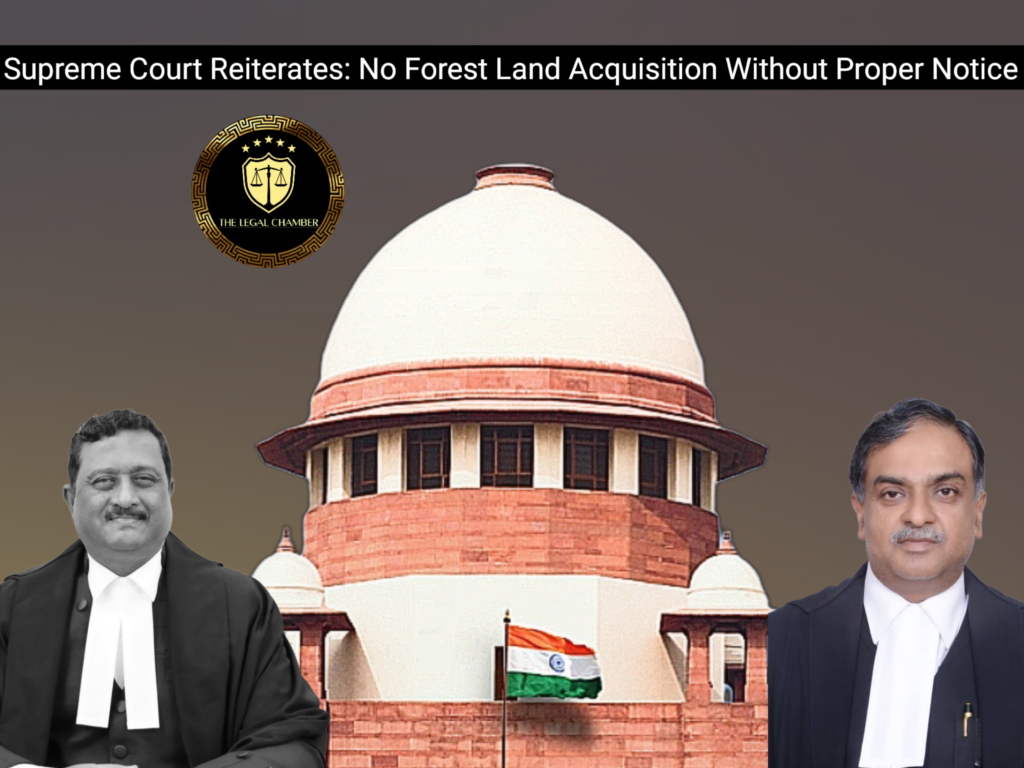
Judges/Justices Name: Justice Vikram Nath and Justice Prasanna B. Varale
Download The Judgement Here