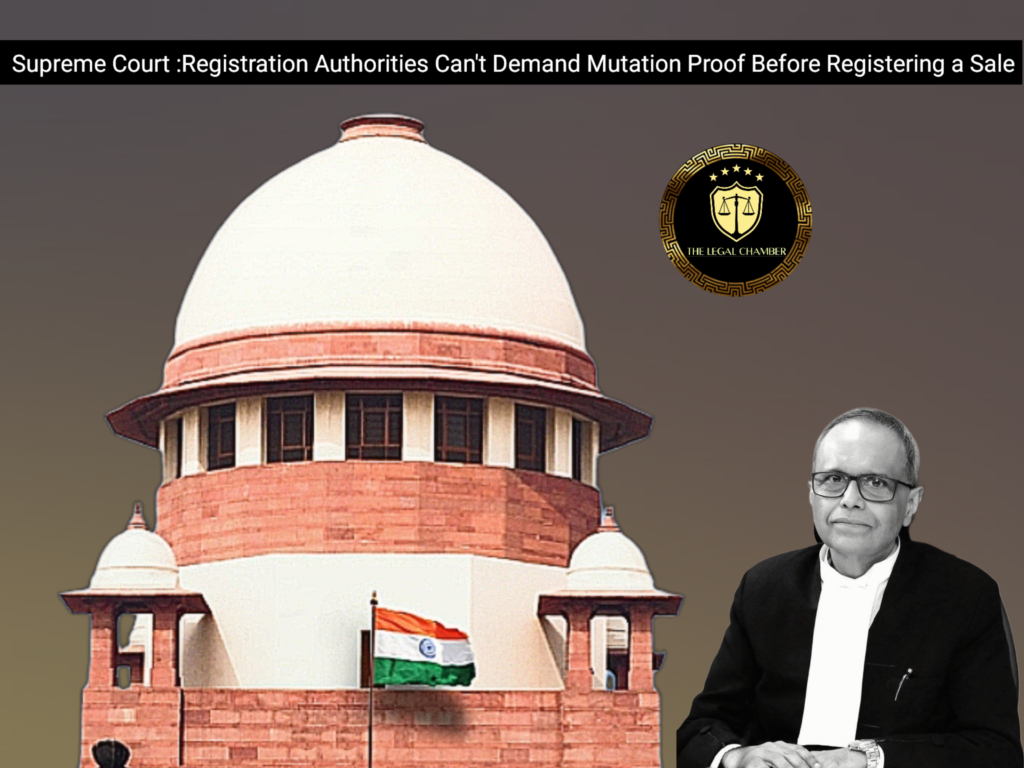
The Supreme Court struck down sub-rules (xvii) and (xviii) of Rule 19 of the Bihar Registration Rules, 2019, holding them ultra vires the Registration Act, 1908. The Court ruled that the rule-making power under Section 69 does not authorize registering authorities to demand proof of mutation or title as a precondition for document registration, deeming such a requirement arbitrary and beyond the scope of the Act.
Facts Of The Case:
Procedural History:
The procedural history of this case began with the appellants filing writ petitions before the Patna High Court, challenging the constitutional and legal validity of sub-rules (xvii) and (xviii) introduced to Rule 19 of the Bihar Registration Rules through a 2019 amendment. The Division Bench of the High Court, after considering the submissions, dismissed the writ petitions, upholding the vires of the impugned sub-rules. Aggrieved by this decision, the appellants pursued Special Leave Petitions (SLPs) before the Supreme Court of India. The Supreme Court granted leave to appeal, condoned the delay, and clubbed the related appeals arising from SLP Diary Nos. 12674 of 2024 and 18064 of 2024. After hearing extensive arguments from both sides, the Supreme Court reversed the High Court’s judgment, allowing the civil appeals and quashing the notification that introduced the contentious sub-rules.
READ ALSO:Supreme Court Sets Aside Mining Tender: “Previous Year” Means Year Before Bid
Court Observation:
The Supreme Court made key observations on the legal and practical aspects of the case. It held that the impugned sub-rules (xvii) and (xviii) were ultra vires the rule-making power under Section 69 of the Registration Act, 1908, as the Act only mandates registration of documents, not verification of title. The Court noted the existing sub-rules of Rule 19 pertained to the identity of the property or executant, while the new rules qualitatively introduced an impermissible pre-condition of proving ownership/mutation.It further observed that making mutation certificates mandatory was arbitrary and illegal, given the admitted ground reality that Bihar’s land survey and mutation process under the 2011 Acts was incomplete, making compliance impossible for most landowners. This created an unreasonable restriction on the right to dispose of property. The Court also used the opportunity to highlight the systemic dichotomy between registration and conclusive title in India, noting its role in extensive property litigation, and suggested the Law Commission examine technological reforms, like blockchain, for a modern, integrated titling system.
Final Decision & Judgement:
The Supreme Court allowed the civil appeals and set aside the judgment of the Patna High Court. The Court quashed Notification No.-IV.M-1-12/2019-3644 dated 10.10.2019, thereby striking down sub-rules (xvii) and (xviii) of Rule 19 of the Bihar Registration Rules. The final decision held that these rules were ultra vires the Registration Act, 1908, as they exceeded the scope of the rule-making power under Section 69. Furthermore, the Court declared the requirement to produce proof of jamabandi or holding allotment as an arbitrary and illegal precondition for registration, as it improperly linked registration with title verification and created an unreasonable barrier to property transactions. The parties were directed to bear their own costs.
Case Details:
Case Title: Samielah vs. The State of Bihar & Ors.
Citation: 2025 INSC 1292
Appeal No:  (Arising out of SLP(C) No(s). of 2025 @ Diary No. 12674/2024)
Date of Judgement: November 7, 2025
Judges/Justice Name: Justice Joymalya Bagchi