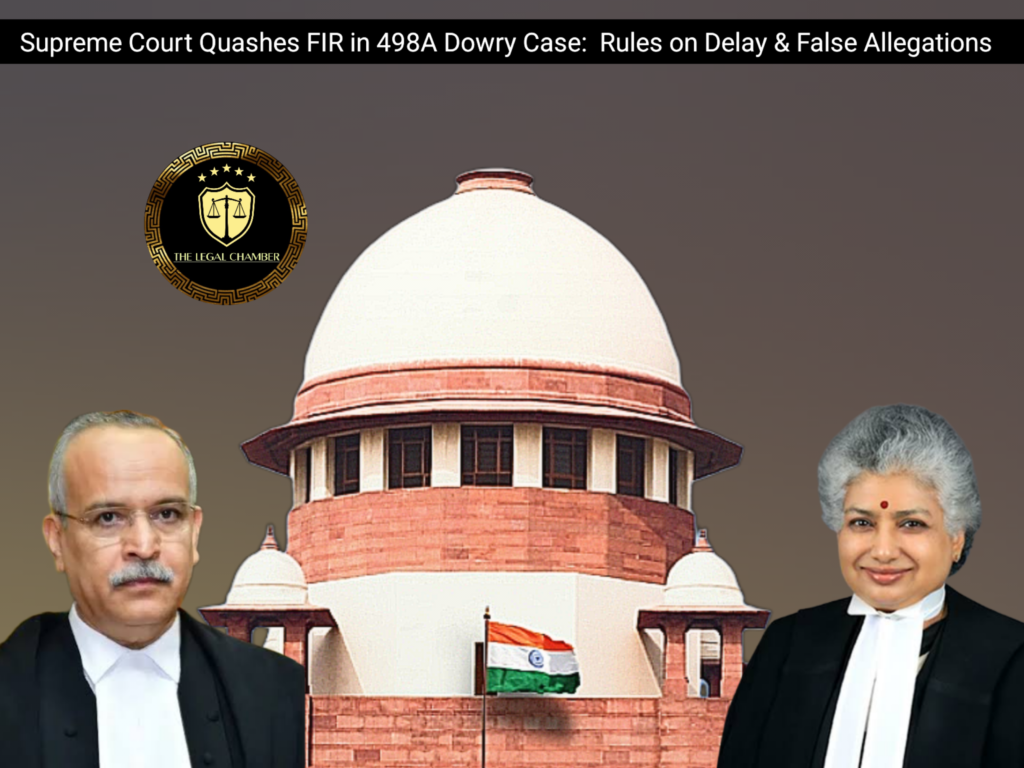
The Supreme Court of India quashed an FIR and chargesheet, holding that while the complaint was within the limitation period as per Section 468 CrPC (relevant date for limitation being filing of complaint, not cognizance date), the allegations lacked specific incidents of cruelty and appeared to be a misuse of legal provisions.
Facts Of The Case:
The present appeal challenges a High Court order dated April 1, 2024, which set aside a Sessions Court order from October 4, 2008. The Sessions Court had discharged the Appellant from charges under Section 498A of the Indian Penal Code, 1860, in FIR No. 1098/2002. The case originated from a complaint filed by the Complainant wife (Respondent no. 2) on July 3, 2002, leading to the FIR being registered on December 19, 2002, at PS Malviya Nagar, against her husband (Appellant) and in-laws, for offenses under Sections 498A, 406, and 34 IPC.The marriage between the Appellant and the Complainant was solemnized on February 28, 1998. The Complainant alleged that soon after the marriage, the Appellant and his family began taunting her for insufficient dowry and made specific demands for cash, a car, and a separate house. She claimed to have suffered physical and mental atrocities, including being beaten and threatened. Following an incident on September 8, 1999, she was allegedly thrown out of the matrimonial home and reported the incidents to the police. The Complainant also alleged a subsequent assault by the Appellant on December 6, 1999, while she was pregnant. A daughter was born on April 27, 2000, but neither the Appellant nor his family visited them. A charge-sheet was filed on July 27, 2004, and charges were framed under Section 498A read with Section 34 IPC on June 4, 2008. The Sessions Court discharged the Appellant, noting the delay in filing the complaint and raising concerns about false implication, particularly given the Complainant’s background as a police officer. The High Court, however, set aside this discharge
Procedural History:
The Complainant filed a formal complaint on July 3, 2002, with the Deputy Commissioner of Police, CAW Cell, New Delhi, detailing alleged incidents of torture since her marriage on February 28, 1998. This complaint led to the registration of FIR No. 1098/2002 on December 19, 2002, at PS Malviya Nagar, under sections 498A, 406, and 34 IPC, against the Appellant husband and her in-laws. The charge-sheet was filed on July 27, 2004, and the Metropolitan Magistrate, Delhi, took cognizance on the same day. On June 4, 2008, the Magistrate framed charges under section 498A read with Section 34 IPC, dropping the charge under section 406 IPC.Aggrieved by the Magistrate’s order, the Appellant filed Criminal Revision Petition No. 87/2008 before the Sessions Court, Delhi. The Sessions Court, in its order dated October 4, 2008, discharged the Appellant, his mother, and five sisters for the offenses under section 498A and 34 IPC, observing that the Magistrate had taken cognizance of a time-barred case.The Complainant then filed a Petition under section 482 CrPC, challenging the Sessions Court’s judgment before the High Court of Delhi. The High Court, through its impugned judgment and final order dated April 1, 2024, allowed the Complainant’s petition and set aside the Sessions Court’s order, finding its findings to be perverse. The current appeal, Criminal Appeal No. 2894 of 2025 (arising out of SLP (Crl.) No. 9709 of 2024), is filed against this High Court judgment. During the Supreme Court proceedings, the Appellant also filed an Application under Article 142 of the Constitution of India seeking to quash the FIR.
READ ALSO:Accidental Death or Murder? Supreme Court’s Landmark Ruling in the Medical Student Case
Court Observation:
The Supreme Court observed that the allegations in the FIR regarding mental and physical cruelty inflicted in 1999 were generic and ambiguous, lacking specific incidents of atrocities. Allegations against family members for instigating the Appellant and taunting the Complainant for insufficient dowry also lacked specific incidents or evidence. The Court found the Complainant’s version implausible and unreliable due to inconsistencies with the evidence. Furthermore, there was no incriminating material or evidence to substantiate “cruelty” under Section 498A IPC, and the Complainant failed to produce medical records or witnesses. The Court noted the Complainant withdrew her second complaint six days after filing it, and there was no evidence of dowry demand.While agreeing with the Sessions Court’s discharge of the Appellants, the Supreme Court deemed the Sessions Court’s reasoning that the Complainant, as a police officer, was “almost immune to be pressurized” erroneous. Conversely, the High Court’s sensitive approach acknowledging that a police officer could also be a victim of cruelty was noted. However, the Court emphasized that a judicial decision must be based on actual facts, and scrutiny revealed no prima facie case against the Appellant or his family. Given the finalized divorce and the alleged incidents pertaining to 1999, continuing the trial would be unjust. The Court condemned the misuse of legal provisions, specifically the implication of aged parents-in-law, five sisters, and a tailor. Lastly, the Court affirmed that the complaint filed on July 3, 2002, was within the three-year limitation period, as the relevant date for computing limitation under Section 468 CrPC is the date of filing the complaint, not the date of taking cognizance.
Final Decision & Judgement:
The Supreme Court, exercising its powers under Article 142 of the Constitution of India, deemed it fit and appropriate to quash and set aside the FIR No. 1098/2002 dated December 19, 2002, registered with PS Malviya Nagar, and the Chargesheet dated July 27, 2004. Both criminal appeals were accordingly allowed. The Court concluded that it was not a case where the complaint or the issuance of process was ex-facie barred by limitation, thereby clarifying that the Magistrate had rightly taken cognizance of the offence under section 498A and the question of applicability or exercise of powers under section 473 CrPC did not arise. This decision was based on the finding that no prima facie case was made out against the Appellant or his family, even if the allegations were accepted in toto. The Court also noted the growing tendency to misuse legal provisions, particularly in matrimonial disputes
Case Details:
Case Title: Ghanshyam Soni Versus State (Govt. of NCT of Delhi) & Anr.
Citation: 2025 INSC 803
Criminal Appeal No.: 2894 of 2025
Date of Judgment: June 04, 2025
Judges/Justice Name: Justice B.V. Nagarathna  and Justice Satish Chandra Sharma
Download The Judgement Here