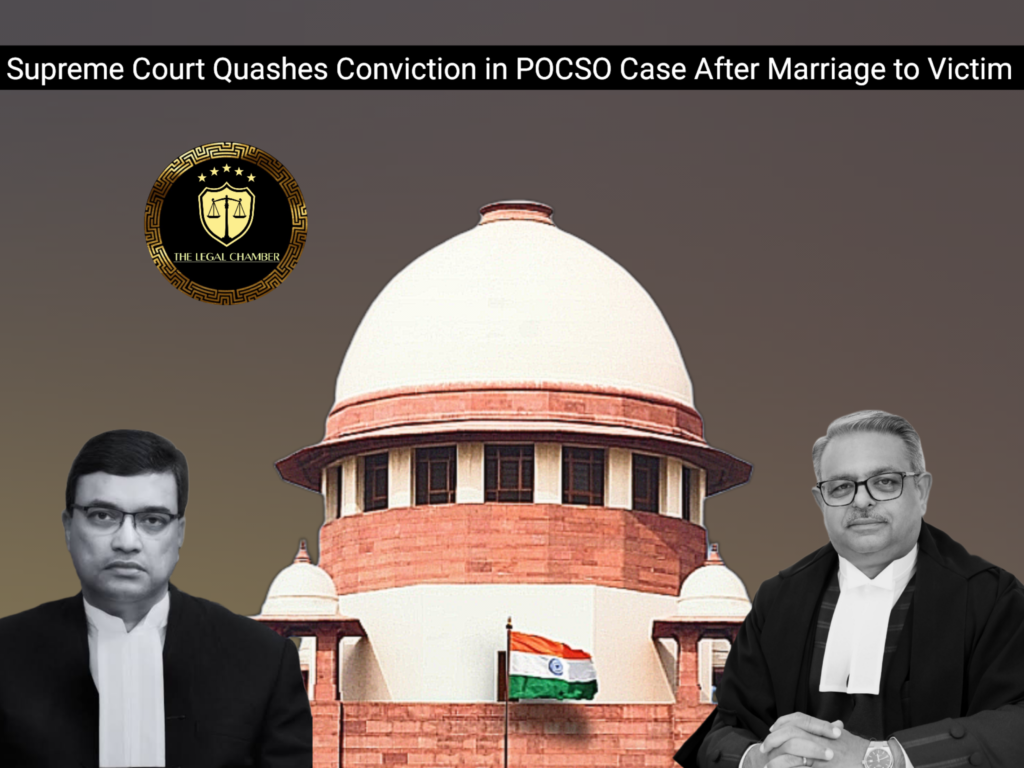
The Supreme Court invoked Article 142 to quash the appellant’s conviction under POCSO and IPC, balancing societal deterrence with familial rehabilitation. The ruling prioritized “complete justice” and marital harmony post-marriage to the victim, imposing a lifelong condition of maintenance and non-desertion, while cautioning against precedent.
Facts Of The Case:
The appellant was convicted under Section 366 of the Indian Penal Code and Section 6 of the POCSO Act, receiving sentences of rigorous imprisonment for 5 and 10 years respectively. His appeal before the Madras High Court was dismissed in September 2021. During the pendency of this appeal, in May 2021, the appellant married the victim. Subsequently, they had a male child. The appellant’s wife filed an affidavit expressing her dependence on him and their desire to lead a peaceful family life. The Tamil Nadu State Legal Services Authority, directed by the Supreme Court, confirmed their well-being and happy marital life. During the Supreme Court hearing, the victim’s father, the complainant, stated he had no objection to ending the criminal proceedings. The core issue before the Court was whether the proceedings could be quashed despite the heinous nature of the offence, considering the subsequent marriage, birth of a child, and the familial harmony at stake.
Procedural History:
The procedural history of the case commenced with the appellant’s conviction by the trial court under Section 366 of the Indian Penal Code and Section 6 of the POCSO Act. Aggrieved by this conviction and sentence, the appellant filed an appeal before the High Court of Judicature at Madras, which was dismissed, upholding the trial court’s judgment. Subsequently, the appellant approached the Supreme Court of India by way of a criminal appeal. During the pendency of this appeal, significant developments occurred, including the solemnization of marriage between the appellant and the victim and the birth of their child. The Supreme Court, upon examining the unique circumstances and invoking its extraordinary constitutional power under Article 142, allowed the appeal and quashed the criminal proceedings, including the conviction and sentence, thereby concluding the legal journey.
READ ALSO:Supreme Court Clarifies Law on Witness Intimidation: Victims Can Go Straight to Police
Court Observation:
The Court observed that while a crime is a wrong against society requiring deterrence, the administration of justice must consider practical realities and a nuanced approach. It noted the subsequent marriage between the appellant and the victim, the birth of their child, and the victim’s expressed dependence and desire for a peaceful family life. The Court discerned that the offence, in this unique context, stemmed from love rather than lust. It held that rigid application of the law would cause irreparable harm to the familial unit and society’s fabric. Balancing the competing interests of justice, deterrence, and rehabilitation, the Court concluded this was a fit case where the law must yield to the cause of complete justice under Article 142 of the Constitution, thereby quashing the proceedings.
Final Decision & Judgement:
The Supreme Court allowed the appeal and, invoking its extraordinary powers under Article 142 of the Constitution of India, quashed the criminal proceedings against the appellant, including his conviction and sentence under Section 366 of the Indian Penal Code and Section 6 of the POCSO Act. The decision was made to secure complete justice, considering the subsequent marriage, the birth of a child, and the need to preserve familial harmony. The Court imposed a specific condition on the appellant to maintain his wife and child with dignity and not desert them for life, warning of consequences for any default. The order was explicitly confined to the case’s unique facts and is not to be treated as a precedent.
Case Details:
Case Title: K. Kirubakaran vs. State of Tamil Nadu
Citation: 2025 INSC 1272
Appeal Number: Criminal Appeal No. 679 of 2024
Date of Judgement: October 28, 2025
Judges/Justices: Justice Dipankar Datta and Justice Augustine George Masih
Download The Judgement Here