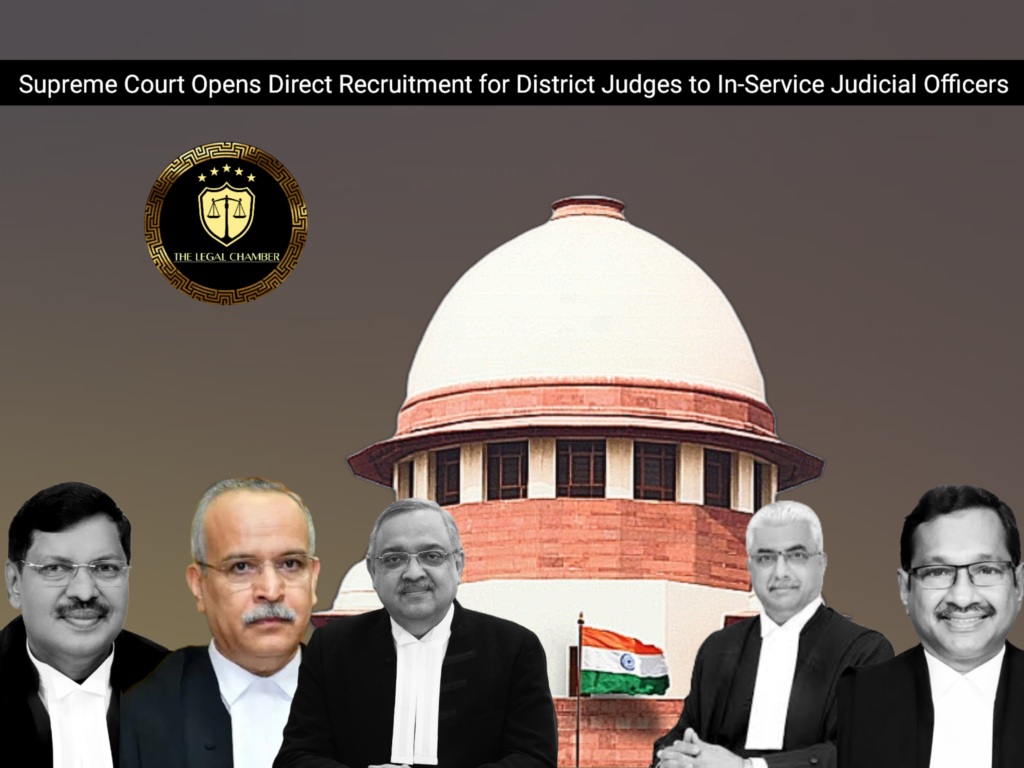
Supreme Court , This Constitution Bench judgment overruled prior rulings from Satya Narain Singh to Dheeraj Mor, holding that Article 233(2) of the Constitution does not bar in-service judicial officers from direct recruitment to District Judge posts. It clarifies that eligibility is determined at the time of application and requires a combined seven-year experience as an advocate and judicial officer.
Facts Of The Case:
The batch of matters arose from conflicting interpretations of Article 233 of the Constitution regarding the eligibility of in-service judicial officers (Civil Judges) for direct recruitment to the post of District Judge. The core legal controversy was triggered by the Supreme Court’s earlier decision in Dheeraj Mor v. High Court of Delhi (2020), which held that for direct recruitment against the quota for advocates, a candidate must be a practising advocate for the immediate past seven years, on the cut-off date, and at the time of appointment, and must not be in judicial service. This excluded serving judicial officers even if they had prior or combined legal experience. Challenging this, judicial officers contended that this interpretation rendered part of Article 233(2) redundant and violated Articles 14 and 16. The questions were referred to a Constitution Bench, which was tasked to decide whether judicial officers with seven years at the Bar are eligible for the “Bar vacancy,” and whether eligibility is to be seen at the time of application or appointment.
Procedural History:
The procedural history of this case originates from a reference order dated August 12, 2025, by a three-judge bench of the Supreme Court, which identified substantial questions of law concerning the interpretation of Article 233 of the Constitution. These questions were subsequently referred for consideration by a Constitution Bench. When the matters were listed for directions on September 12, 2025, the Constitution Bench framed additional questions to comprehensively address the eligibility of in-service judicial officers for direct recruitment to the post of District Judge. The batch collectively disposed of a multitude of connected civil appeals, writ petitions, review petitions, and miscellaneous applications that had challenged the restrictive interpretation laid down in the earlier three-judge bench decision of Dheeraj Mor v. High Court of Delhi (2020). The Constitution Bench, after extensive hearings, delivered the present judgment to settle the law.
READ ALSO:When a Contract Becomes Void: Supreme Court Explains the Limits of Specific Performance
Court Observation:
The Constitution Bench made several key observations in overruling the line of cases from Satya Narain Singh to Dheeraj Mor. It held that a textual and contextual interpretation of Article 233 reveals two distinct sources for appointment as District Judge: persons in judicial service and advocates/pleaders. The Court observed that Clause (2) of Article 233 prescribes eligibility only for those “not already in service,” meaning advocates must have seven years of practice, whereas no such qualifying period is prescribed for in-service candidates. It found that excluding judicial officers from direct recruitment would render the phrase “a person not already in the service” in Article 233(2) redundant and otiose, which is impermissible. The Bench further observed that such an exclusion violates Articles 14 and 16 of the Constitution by creating an impermissible “quota” for advocates and denying equal opportunity to meritorious judicial officers. It emphasized that the doctrine of stare decisis is not inflexible, especially when a prior interpretation is erroneous and causes injustice.
Final Decision & Judgement:
The Supreme Court, in its final decision, answered the referred questions in favour of the in-service judicial officers. It held that judicial officers who have completed seven years at the Bar prior to joining service are eligible to compete for District Judge posts through direct recruitment. The Court ruled that eligibility is to be determined at the time of application. While Article 233(2) prescribes no specific eligibility for in-service candidates, to ensure a level playing field, it directed that such candidates must have a combined seven years of experience as an advocate and a judicial officer. The judgment overruled the contrary interpretations laid down in Satya Narain Singh (1985) and Dheeraj Mor (2020), declaring they did not state the correct law. Consequently, all state rules inconsistent with this ruling were quashed, and states were directed to frame or amend rules in consultation with their respective High Courts within three months.
Case Details:
Case Title: Rejanish K.V. vs. K. Deepa and Others
Citation: 2025 INSC 1208
Civil Appeal No.: Civil Appeal No. 3947 of 2020
Date of Judgement: October 09, 2025
Judges/Justice Name: Justice B.R. Gavai & Justice Aravind Kumar & Satish Chandra Sharma & K. Vinod Chandran & Justice M.M. Sundresh
Download The Judgement Here