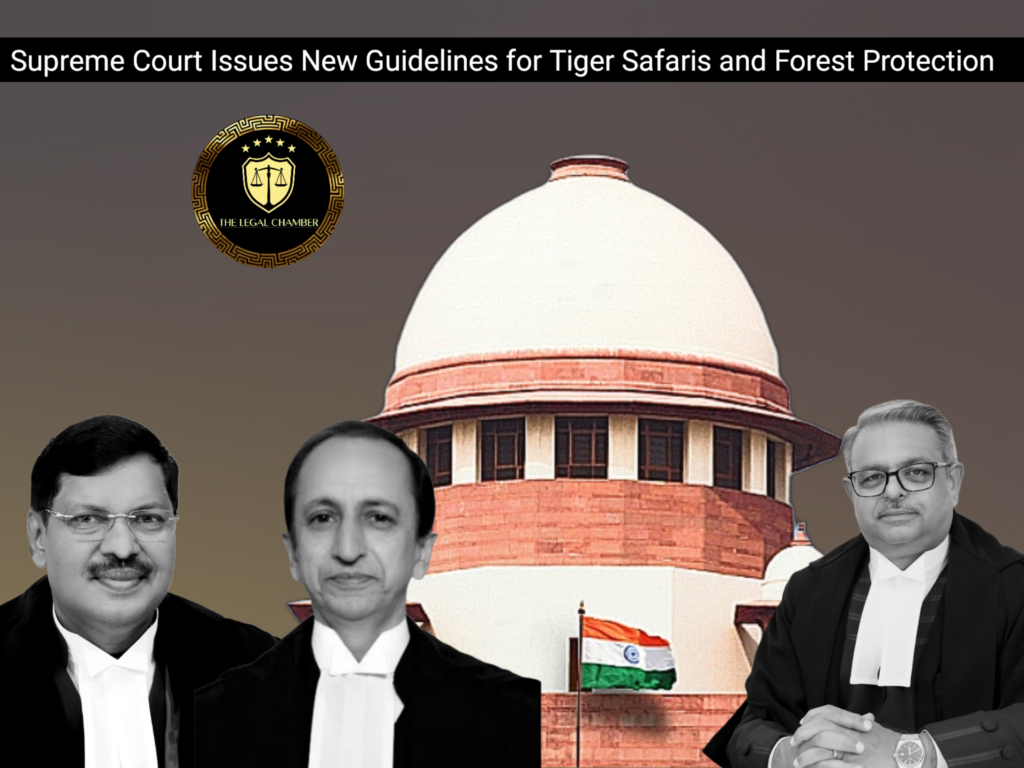
The Supreme Court upheld and expanded upon its March 2024 directions concerning tiger conservation. It mandated that Tiger Safaris may only be established on non-forest or degraded land within buffer zones, provided they are not part of tiger corridors and are integrated with rescue centres. The Court accepted the Expert Committee’s recommendations, directing the notification of Eco-Sensitive Zones for all Tiger Reserves and imposing strict regulations on activities within buffer and fringe areas to prioritize an ecocentric approach.
Facts Of The Case:
The case originated from an application by Shri Gaurav Kumar Bansal concerning illegal constructions and felling of trees within the Corbett Tiger Reserve, particularly for establishing a Tiger Safari at Pakhrau. Following its detailed judgment in March 2024, the Supreme Court constituted an Expert Committee to investigate the environmental damage, recommend restoration measures, and formulate guidelines for Tiger Safaris and activities in buffer zones. The Committee submitted its report, and the present judgment addresses those recommendations.The key factual background involves the damage caused to the Corbett Tiger Reserve ecosystem due to unauthorized construction and tree felling for the safari project. Parallel proceedings included a CBI investigation, which culminated in a chargesheet against several forest officials, and ongoing disciplinary actions by the State of Uttarakhand. The Court’s task was to evaluate the Expert Committee’s findings on ecological restoration, the permissibility of Tiger Safaris, and comprehensive management protocols for all Tiger Reserves across India, based on principles of ecocentrism and the precautionary principle.
Procedural History:
The procedural history of this case stems from the Supreme Court’s judgment dated March 6, 2024, in the ongoing Writ Petition (C) No. 202 of 1995 (T.N. Godavarman case). In that order, the Court issued a series of directions, including the constitution of a four-member Expert Committee by the MoEF&CC to conduct an in-depth inquiry and make recommendations on various aspects concerning Tiger Safaris and the damage to Corbett Tiger Reserve. The Committee was tasked with suggesting restoration measures, assessing environmental damage, identifying responsible officials, and formulating guidelines.Pursuant to its formation on March 15, 2024, the Expert Committee conducted field visits, held meetings, consulted experts, and submitted its report. The Supreme Court then heard arguments from the Amicus Curiae, the Additional Solicitor General, and the applicant-in-person on the Committee’s findings. Simultaneously, the Court monitored two other independent proceedings it had initiated: the CBI investigation, which filed a chargesheet and was subsequently disposed of in May 2025, and the disciplinary proceedings against delinquent forest officers by the State of Uttarakhand. The present judgment of November 17, 2025, is the culmination of this process, wherein the Court examines the Expert Committee’s report and issues comprehensive, binding directions.
READ ALSO:Supreme Court Acquits Accused in Murder Case: Recovery of Weapon Alone is Not Proof
Court Observation:
In its observations, the Supreme Court emphasized the paramount importance of adopting an ecocentric, rather than anthropocentric, approach to wildlife conservation, placing the restoration of damaged ecosystems at the core of environmental jurisprudence. The Court reiterated that the principle of restitution, rooted in constitutional mandates (Articles 21, 48A, and 51A(g)) and international obligations like the Convention on Biological Diversity, requires not just compensation but active ecological restoration to its original state.The Court affirmed that Tiger Reserves must be kept at a higher pedestal of protection than other protected areas. It observed that while regulated eco-tourism could be a tool for conservation and community benefit, it must strictly adhere to the precautionary principle to cause the least environmental damage. The Bench underscored that the buffer and fringe areas of Tiger Reserves are integral to landscape connectivity and tiger dispersal, warranting protection equivalent to Eco-Sensitive Zones, and stressed the urgent need for adequate funding, specialized human resources, and stringent regulation to ensure the effective management and long-term survival of tiger populations in India.
Final Decision & Judgement:
The Supreme Court, in its final judgment, accepted the comprehensive recommendations of the Expert Committee and issued a series of binding directions. For Corbett Tiger Reserve, Uttarakhand was directed to implement an ecological restoration plan under the CEC’s supervision. Nationally, the Court ruled that Tiger Safaris are prohibited in core/critical habitats and may only be established on non-forest or degraded land within buffer zones, provided they are not part of tiger corridors and are integrated with a rescue centre.Furthermore, the Court directed all State Governments to notify Eco-Sensitive Zones for every Tiger Reserve within one year, applying stringent restrictions on activities like mining and polluting industries. It mandated the preparation of Tiger Conservation Plans, the creation of Steering Committees, and a complete overhaul of human resource and funding policies for tiger reserves, including a ban on night tourism. The MoEF&CC and NTCA were tasked with framing model guidelines for human-wildlife conflict and a funding policy within six months, applying these directives uniformly across all Tiger Reserves in India.
Case Details:
Case Title: In Re: Corbett (in Writ Petition (C) No. 202 of 1995 - T. N. Godavarman Thirumulpad vs. Union of India & Others)
Case Number:  Writ Petition (C) No. 202 of 1995.
Date of Judgement: November 17, 2025.
Judges/Justice Name:  Justice B.R. Gavai & Justice Augustine George Masih & Justice A.S. Chandurkar
Download The Judgement Here