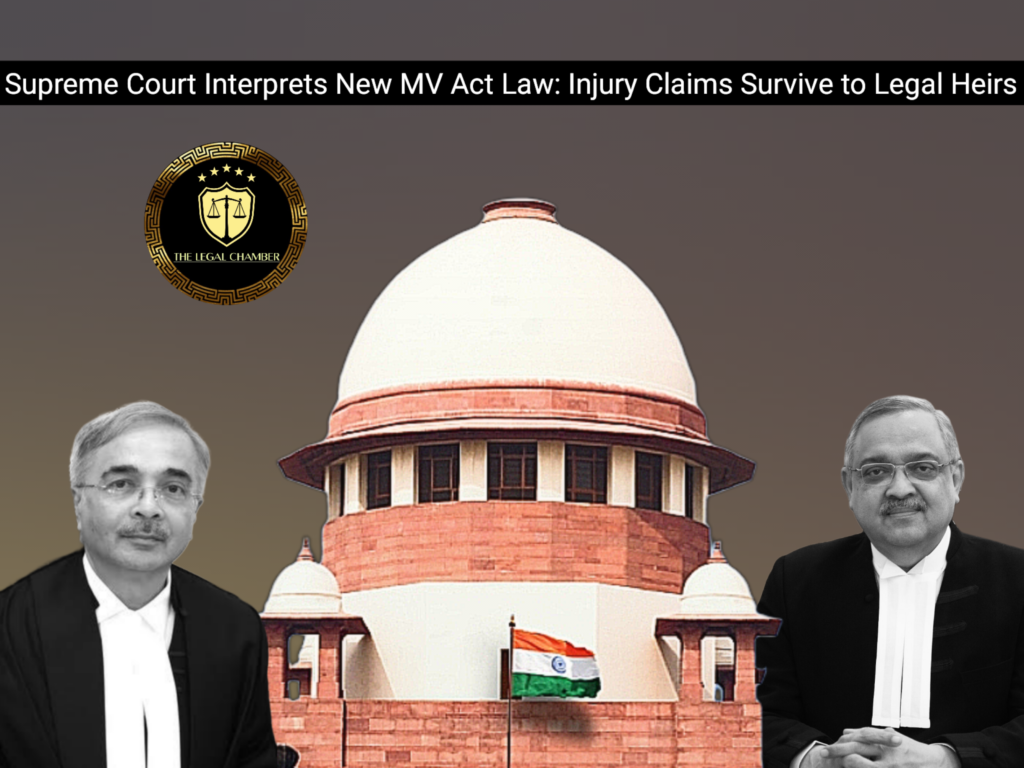
This Supreme Court judgment clarifies that under Section 167(5) of the Motor Vehicles Act, 1988, inserted by Act 32 of 2019, the right to claim compensation for personal injuries survives to the legal representatives of an injured person upon their death. This survival of the cause of action is applicable irrespective of whether the death has any nexus to the accident injuries. The Court thus overruled the contrary view taken in Bhagwati Bai.
Facts Of The Case:
Procedural History:
The procedural history of this case began with the original claimant filing for compensation before the Motor Accidents Claims Tribunal for injuries sustained in a motor accident. Dissatisfied with the Tribunal’s award, the claimant appealed to the High Court, which enhanced the compensation. Still aggrieved, the claimant then filed the present civil appeal in the Supreme Court, seeking further enhancement. During the pendency of this appeal, the claimant died, leading to his substitution by his legal representatives. The respondent insurance company raised a preliminary objection against this substitution, arguing that the personal injury claim abated upon the claimant’s death. The Supreme Court first adjudicated this legal issue, allowing the appeal to continue, and then proceeded to hear the matter on merits to determine the final enhanced compensation.
READ ALSO:Supreme Court Limits Clubbing of Multi-State FIRs in Financial Fraud Case
Court Observation:
The Supreme Court made pivotal observations on the survival of a personal injury claim. It authoritatively held that, by virtue of the newly inserted Section 167(5) of the Motor Vehicles Act, 1988, the right to claim compensation for injuries survives to the legal representatives of a deceased injured person. This legal right persists irrespective of whether the death was caused by the accident injuries or by an unrelated cause. On the quantum of compensation, the Court observed that the calculation must be for the loss caused to the estate of the deceased injured. Consequently, it modified the multiplier to be applied, aligning it with the victim’s actual post-accident survival period rather than his expected working life, to prevent a windfall to the legal heirs and to ensure “just compensation” is strictly awarded for the actual loss to the estate.
Final Decision & Judgement:
The Supreme Court allowed the appeal and set aside the impugned order of the High Court. On the preliminary issue, it overruled the objection raised by the insurance company and held that the cause of action survived to the legal representatives of the deceased-injured claimant by virtue of Section 167(5) of the Motor Vehicles Act, 1988. On the merits, the Court enhanced the total compensation to Rs. 20,37,095. This amount was to carry interest at the rate of 9% per annum from the date of the filing of the claim petition until the date of actual payment. The respondent insurance company was directed to pay the balance amount, after deducting any sums already paid, within a period of three months from the date of the judgment.
Case Details:
Case Title: Dhannalal Alias Dhauraj (Dead) Thr. LRs.  Versus Nasir Khan and Ors.
Citation: 2025 INSC 1177
Appeal Number: Civil Appeal No. 2159 of 2024
Date of Judgement: September 26, 2025
Judges/Justice Name: K. Vinod Chandran and N. V. Anjaria
Download The Judgement Here