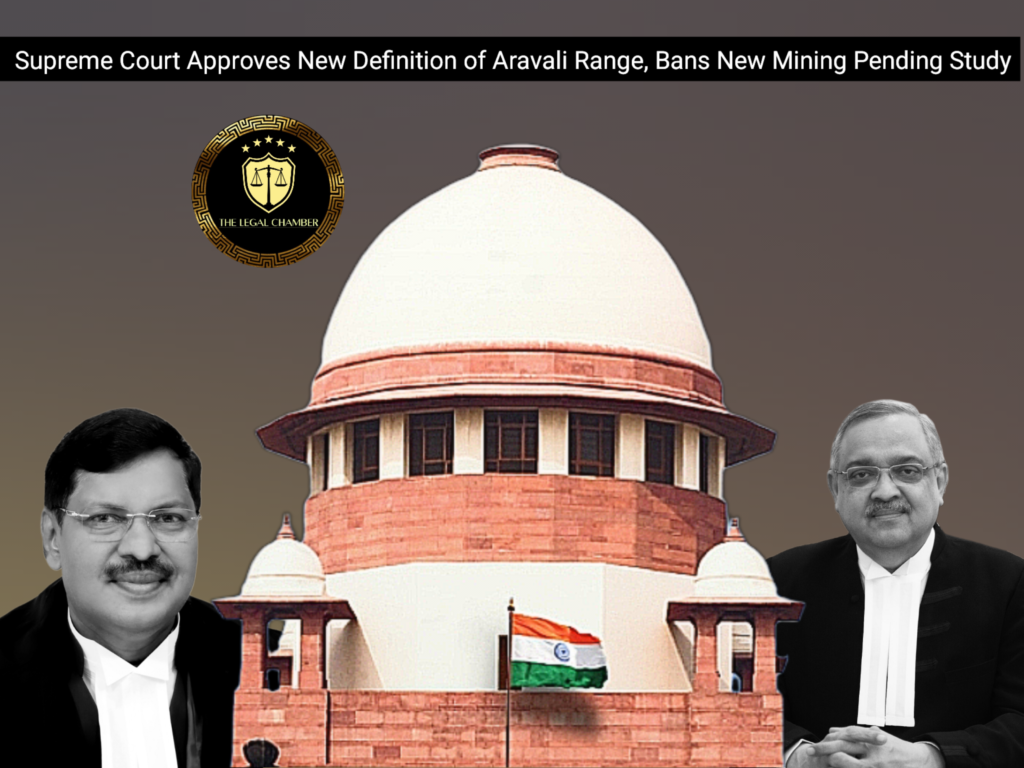
The Supreme Court, while accepting a committee’s operational definition of the Aravali Hills and Ranges for mining regulation, directed the preparation of a Management Plan for Sustainable Mining. This plan must identify conservation zones and permissible mining areas based on ecological carrying capacity. The Court ordered that no new mining leases be granted until this scientific study is finalized, balancing environmental protection with regulated mining activities.
Facts Of The Case:
The case originated from issues raised in the long-standing writ petition, T.N. Godavarman Thirumulpad v. Union of India, concerning the conservation of forests. A specific question arose before the Supreme Court in January 2024 regarding whether certain mining activities in Rajasthan fell within the legally protected Aravali Hills. The Court noted conflicting definitions of “Aravali Hills/Ranges” across different states, which complicated regulatory enforcement and led to illegal mining. To resolve this, the Court constituted a Central Empowered Committee (CEC) to examine the classification. Subsequently, in May 2024, the Court formed a special committee of central and state officials to devise a uniform definition for the Aravali Hills and Ranges across Delhi, Haryana, Rajasthan, and Gujarat. This committee submitted its report in October 2025, proposing an operational definition and recommendations for regulating and prohibiting mining in ecologically sensitive core areas. The core legal dispute before the Court was whether to accept this committee’s definition and regulatory framework or to mandate a more comprehensive ecological study, similar to one previously conducted for the Saranda forest, before permitting any further sustainable mining in the fragile Aravali ecosystem.
Procedural History:
The procedural history of this case is anchored in the Supreme Court’s ongoing supervision of the T.N. Godavarman Thirumulpad writ petition (No. 202 of 1995). In January 2024, the Court identified a specific issue regarding the definition of the Aravali Hills and its impact on mining permissions. It referred the matter to the Central Empowered Committee (CEC) for examination. Following the CEC’s report in March 2024, the Court, in May 2024, constituted a special committee of central and state experts to formulate a uniform definition for the Aravali ranges across four states. After granting extensions, the committee submitted its final report in October 2025. The Court then heard arguments on this report, culminating in the present judgment of November 20, 2025, which accepted the committee’s recommendations but imposed the additional requirement of a comprehensive Management Plan for Sustainable Mining before any new leases could be granted.
READ ALSO:Direct Recruits vs. Promotees: Supreme Court Lays Down Seniority Rules for Higher Judiciary
Court Observation:
The Court observed that the Aravali Range is an ancient and ecologically critical “green barrier” against desertification, requiring stringent protection under India’s international commitments. It noted the lack of a uniform definition for the Aravali Hills across states was a major cause of illegal mining and regulatory failure. While appreciating the expert committee’s work in proposing an operational definition and core inviolate areas, the Court emphasized that the range’s unique biodiversity and geological fragility warranted a more detailed, science-based assessment before permitting new mining activities. It drew a parallel to the Saranda forest case, holding that a similar geo-referenced Management Plan for Sustainable Mining (MPSM) was essential to identify conservation zones and areas where sustainable mining could be ecologically justified, thereby balancing environmental imperatives with regulated resource use.
Final Decision & Judgement:
In its final judgment, the Supreme Court accepted the expert committee’s recommended uniform definition of the Aravali Hills and Ranges, along with its framework for prohibiting mining in designated core/inviolate areas and promoting sustainable mining. However, critically, the Court directed the MoEF&CC to prepare a comprehensive Management Plan for Sustainable Mining (MPSM) for the entire Aravali region through the Indian Council of Forestry Research and Education. This scientific plan must identify conservation-critical zones and permissible mining areas based on ecological carrying capacity. Until the MPSM is finalized, no new mining leases are to be granted. Existing legal mining operations are permitted to continue but must strictly comply with the committee’s regulatory recommendations.
Case Details:
Case Title: In Re: T.N. Godavarman Thirumulpad vs. Union of India and Others
CITATION: 2025 INSC 1338
Appeal No.: I.A. No.105701 of 2024
Date of Judgement: November 20, 2025
Judges/Justices Name: Justice B.R. Gavai and Justice K. Vinod Chandran
Download The Judgement Here