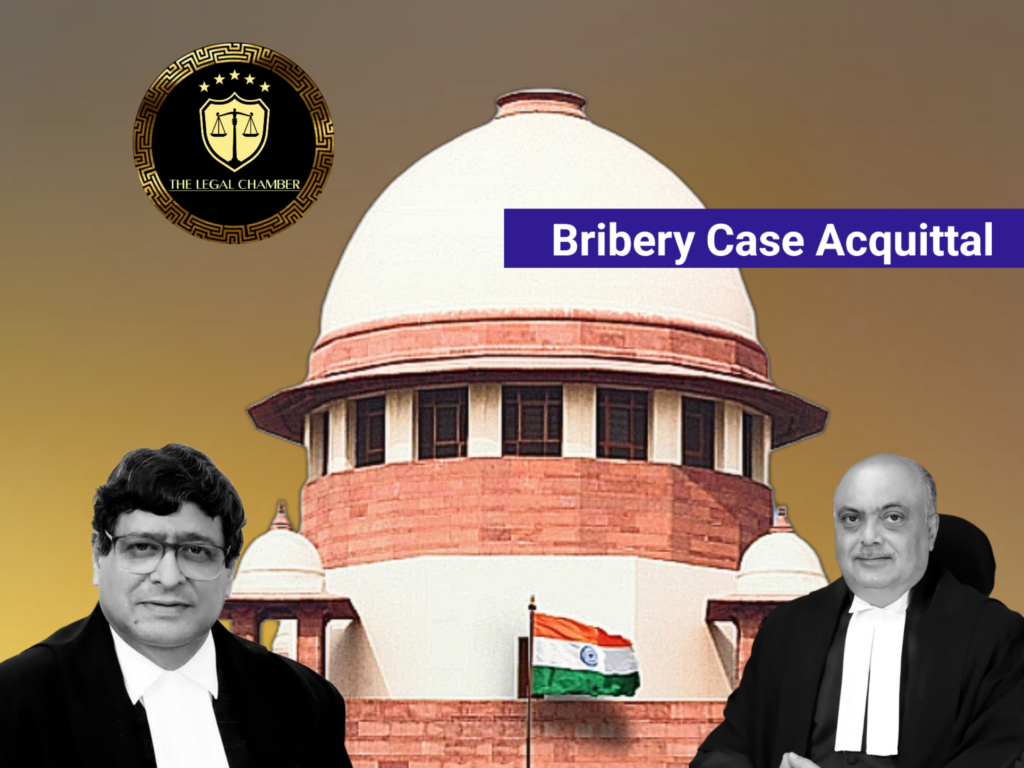
The Supreme Court set aside the conviction of a revenue officer under Sections 7 and 13(1)(d) read with 13(2) of the Prevention of Corruption Act, holding that the prosecution failed to prove the demand and acceptance of bribe beyond reasonable doubt, thus negating the presumption under Section 20 of the Act.
Facts Of The Case:
The case involves Partiala Sudhakar, a Revenue Inspector in the Mandal Revenue Office, Gundala Mandal, Nalgonda District, who was convicted under Sections 7 and 13(1)(d) read with Section 13(2) of the Prevention of Corruption Act, 1988. The prosecution alleged that on August 6, 2003, Sudhakar demanded a bribe of Rs. 2,000 from the complainant (PW1) to process his application for drought compensation for damaged trees. When PW1 expressed inability to pay, Sudhakar insisted on the payment and directed him to bring the money to his residence on August 11, 2003. PW1 reported the demand to the Anti-Corruption Bureau (ACB), which laid a trap.
During the trap, the tainted money was placed in a rexine bag attached to Sudhakar’s motorcycle, but the phenolphthalein test on his hands yielded negative results. The Trial Court and the High Court convicted Sudhakar, relying on the recovery of the money and witness testimonies. However, the Supreme Court found material contradictions in the evidence, including discrepancies in witness statements and the absence of independent verification of the demand. The Court also noted prior animus between Sudhakar and PW1, casting doubt on the prosecution’s case. Consequently, the Supreme Court acquitted Sudhakar, extending the benefit of doubt and quashing the lower courts’ judgments.
Procedural History:
The procedural history of the case begins with the conviction of Partiala Sudhakar by the Trial Court (Additional Special Judge for Special Police Establishment & Anti-Corruption Bureau Cases, Hyderabad) on January 29, 2008, under Sections 7 and 13(1)(d) read with Section 13(2) of the Prevention of Corruption Act, 1988. He was sentenced to rigorous imprisonment for one year and fined Rs. 1,000 for each offense. Dissatisfied with the verdict, Sudhakar filed Criminal Appeal No. 157 of 2008 before the High Court of Telangana at Hyderabad, which upheld the Trial Court’s judgment on March 6, 2024. The High Court affirmed that the prosecution had proved the demand and acceptance of the bribe beyond reasonable doubt.
Subsequently, Sudhakar approached the Supreme Court through a Special Leave Petition (Criminal) No. 6066 of 2024, which was converted into Criminal Appeal No. [X] of 2025. The Supreme Court, after examining material contradictions in witness testimonies and the lack of independent verification of the bribe demand, set aside the conviction on May 9, 2025, granting Sudhakar the benefit of doubt and quashing the judgments of the lower courts. The Court also ordered the refund of the fine, if deposited, within four weeks.
Court Observation:
The Supreme Court made several critical observations while overturning the conviction of Partiala Sudhakar. It noted material contradictions in the prosecution’s case, particularly regarding the demand and acceptance of the bribe. The Court highlighted that the phenolphthalein test on Sudhakar’s hands yielded negative results, casting doubt on whether he had actually handled the money. It also pointed out discrepancies in witness testimonies, including the complainant’s (PW1) inconsistent statements about whether Sudhakar was present when the money was placed in the rexine bag of his motorcycle. The Court observed that independent witnesses did not corroborate the demand, and the trap proceedings lacked proper verification, as mandated in precedents like Mir Mustafa Ali Hasmi v. State of A.P. (2024). Additionally, the Court noted a prior altercation between Sudhakar and the complainant, suggesting possible mala fide intent behind the complaint. Relying on Om Parkash v. State of Haryana (2006), the Court ruled that Section 20 of the Prevention of Corruption Act (presumption of guilt) does not apply when the demand itself is unproven. Ultimately, the Court held that the prosecution failed to establish guilt beyond reasonable doubt, warranting Sudhakar’s acquittal.
Final Decision & Judgement:
The Supreme Court, in its final judgment dated May 9, 2025, allowed the appeal and acquitted Partiala Sudhakar, setting aside his conviction under Sections 7 and 13(1)(d) read with Section 13(2) of the Prevention of Corruption Act, 1988. The Court held that the prosecution had failed to prove the charges beyond reasonable doubt, citing material contradictions in witness testimonies, the absence of independent verification of the bribe demand, and the negative phenolphthalein test result.
Emphasizing the presumption of innocence in criminal jurisprudence, the Court extended the benefit of doubt to Sudhakar, quashing the judgments of both the Trial Court and the High Court. It directed the refund of the fine if already deposited and exempted Sudhakar from surrendering, as he had previously been granted bail. The judgment reaffirmed the necessity of strict scrutiny in corruption cases, particularly where animus or procedural lapses cast doubt on the prosecution’s case. No costs were awarded, and the appeal was disposed of accordingly.
Case Details:
Case Title: Partiala Sudhakar vs. State of Telangana

Citation: 2025 SCC OnLine SC [INSC 655] (Exact SCC volume number to be updated upon official publication)

Criminal Appeal No.: Criminal Appeal No. [X] of 2025 (Arising from SLP (Crl.) No. 6066 of 2024)

Date of Judgment: May 9, 2025

Judges/Justice Name: Hon'ble Mr. Justice Sudhanshu Dhulia & Hon'ble Mr. Justice Ahsanuddin Amanullah
Download The Judgement Here