Facts Of The Case:
Procedural History:
The case originated with the registration of FIR No. 233/2014 against the appellant. The investigation sought a DNA test, which a Judicial Magistrate ordered, but the appellant did not comply. Respondent No. 1, seeking faster progress, filed W.P. (MD) No. 7746 of 2015 for transfer of investigation, which was partially allowed. Dissatisfied, she filed another writ petition, W.P. (MD) No. 15208 of 2016, specifically seeking a DNA test. The Single Judge initially granted interim relief for the test, but the Division Bench in W.A. (MD) No. 1428 of 2016 set it aside due to lack of hearing. On remand, the Single Judge, after hearing, passed a final order on 24.04.2017 directing the DNA test. The appellant’s appeal against this order, W.A. (MD) No. 521 of 2017, was dismissed by the Division Bench on 10.05.2017, affirming the direction. This impugned judgment of the High Court was challenged before the Supreme Court in the present Criminal Appeal No. 1013 of 2021, which ultimately set aside the DNA test order.
READ ALSO:Additional Premium vs. Policy Breach: Supreme Court Settles Insurance Dispute in Favor of Claimant
Court Observation:
The Supreme Court observed that the conclusive presumption of legitimacy under Section 112 of the Indian Evidence Act operates in favour of the child born during a valid marriage. This presumption can only be rebutted by strong, cogent evidence proving “non-access” between the spouses, which was entirely absent in this case. The Court held that a DNA test is an extreme intrusion into privacy and bodily autonomy and cannot be ordered as a matter of routine or for a “roving inquiry.” It emphasized that such a direction requires a stringent test of “eminent need” and a direct nexus to the alleged offence, neither of which was established here. The offences of cheating and harassment could be adjudicated without delving into paternity, making the forced DNA test disproportionate and unjustified. The High Court’s reliance on Sections 53 and 53-A of the Cr.P.C. was misplaced, as these provisions require the examination to directly yield evidence of the crime.
Final Decision & Judgement:
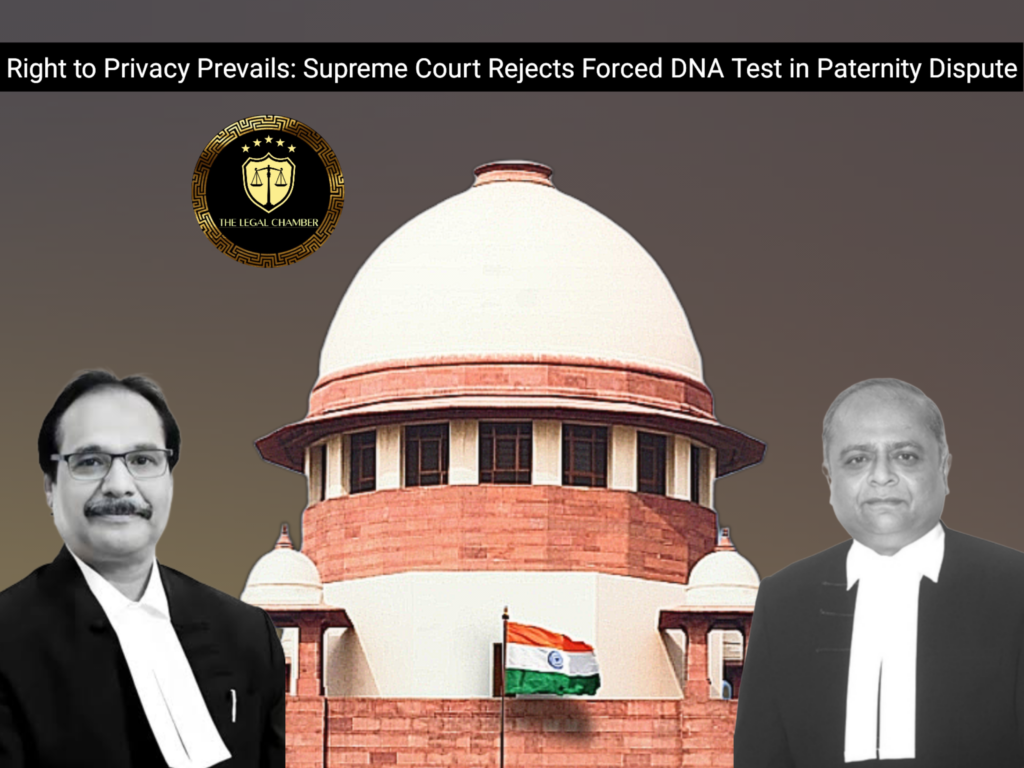
The Supreme Court allowed the appeal and set aside the impugned judgment of the Madras High Court dated 10.05.2017. It held that the direction for compelled DNA testing of the appellant was legally unsustainable. The Court ruled that the statutory presumption of the child’s legitimacy under Section 112 of the Evidence Act remained unrebutted, as the respondent failed to plead or prove “non-access” between herself and her husband. Furthermore, it found no “eminent need” for the test, as the alleged offences of cheating and harassment had no direct nexus with the determination of biological paternity. The order was deemed a disproportionate invasion of the appellant’s right to privacy and bodily autonomy, violating constitutional safeguards under Articles 20(3) and 21.
Case Details:
Case Title: R. Rajendran vs. Kamar Nisha and Others
Citation: 2025 INSC 1304
Appeal Number: Criminal Appeal No. 1013 of 2021
Date of Judgement: November 10, 2025
Judges/Justice Name: Justice Prashant Kumar Mishra and Justice Vipul M. Pancholi
Download The Judgement Here