Facts Of The Case:
On August 15, 2021, the appellant, Dinesh Kumar Jaldhari, returned to the victim’s home in Jashpur, Chhattisgarh, with her father and another man after collecting wood. After consuming alcohol, the victim’s four-year-old daughter was sleeping inside. Around 4:30 p.m., the mother went inside to give food to the appellant and found him wearing only shorts, sitting near her daughter’s legs. The child’s underwear was pulled down to her knees and her frock was raised. Upon being confronted, the appellant fled. The mother discovered her daughter crying, complaining of pain in her private part, which was found to be wet. An FIR was lodged under relevant sections of the IPC and the POCSO Act. The medical examination confirmed the child’s age as four years and noted redness in her vagina but found no external injuries or bleeding. During trial, the victim became extremely frightened upon seeing the accused in court and was unable to testify. Relying on the consistent testimonies of the parents and the victim’s traumatized behavior, the trial court convicted the appellant. The High Court upheld the conviction, which was subsequently appealed to the Supreme Court.
Procedural History:
The case originated with the filing of FIR No. 52 of 2021 at Duldula Police Station against the appellant for offences under the IPC and the POCSO Act. After investigation, a chargesheet was filed. The learned Special Judge (POCSO), Kunkuri, convicted the appellant under Sections 9(m) and 10 of the POCSO Act on April 18, 2023, sentencing him to seven years of rigorous imprisonment and a fine. The appellant’s criminal appeal (CRA No. 1348 of 2023) was dismissed by the High Court of Chhattisgarh on March 6, 2025, which confirmed the trial court’s judgement. The appellant then filed Criminal Appeal No. 4732 of 2025 before the Supreme Court of India, which partly allowed the appeal on November 13, 2025. The Supreme Court upheld the conviction but reduced the sentence from seven to six years of rigorous imprisonment, while maintaining the fine and default imprisonment.
READ ALSO:Supreme Court Restores Dismissal, Limits Judicial Review in Disciplinary Cases
Court Observation:
The Court observed that the consistent and cogent ocular evidence of the victim’s parents, particularly the mother (PW-3), who discovered the appellant in a compromising position with the child, was reliable and inspired confidence. It held that in cases of sexual assault against a minor, medical evidence taking a “backseat” is a settled legal principle, and the absence of injuries or penetration does not negate the offence when eyewitness testimony is credible. The Court placed significant reliance on the victim’s traumatized behavior in court—becoming frightened and unable to testify upon seeing the accused—as a corroborative “pointer” to the truth of the incident. It found no merit in the appellant’s plea for benefit of doubt, concluding that the prosecution had successfully proved the commission of aggravated sexual assault under the POCSO Act beyond reasonable doubt.
Final Decision & Judgement:
In its final decision, the Supreme Court partly allowed the criminal appeal. While it unequivocally upheld the appellant’s conviction under Sections 9(m) and 10 of the POCSO Act, 2012, for the offence of aggravated sexual assault on a child, it modified the sentence. The Court reduced the period of rigorous imprisonment from the maximum of seven years, as imposed by the courts below, to a term of six years. The imposition of a fine of ₹6,000, along with a default simple imprisonment of one year for non-payment, was confirmed to stand. Consequently, the judgment and order of the High Court were modified only to this limited extent regarding the quantum of sentence.
Case Details:
Case Title: Dinesh Kumar Jaldhari vs. State of Chhattisgarh
Citation: Criminal Appeal No. 4732 of 2025
Appeal Type: Criminal Appeal
Date of Judgement: November 13, 2025
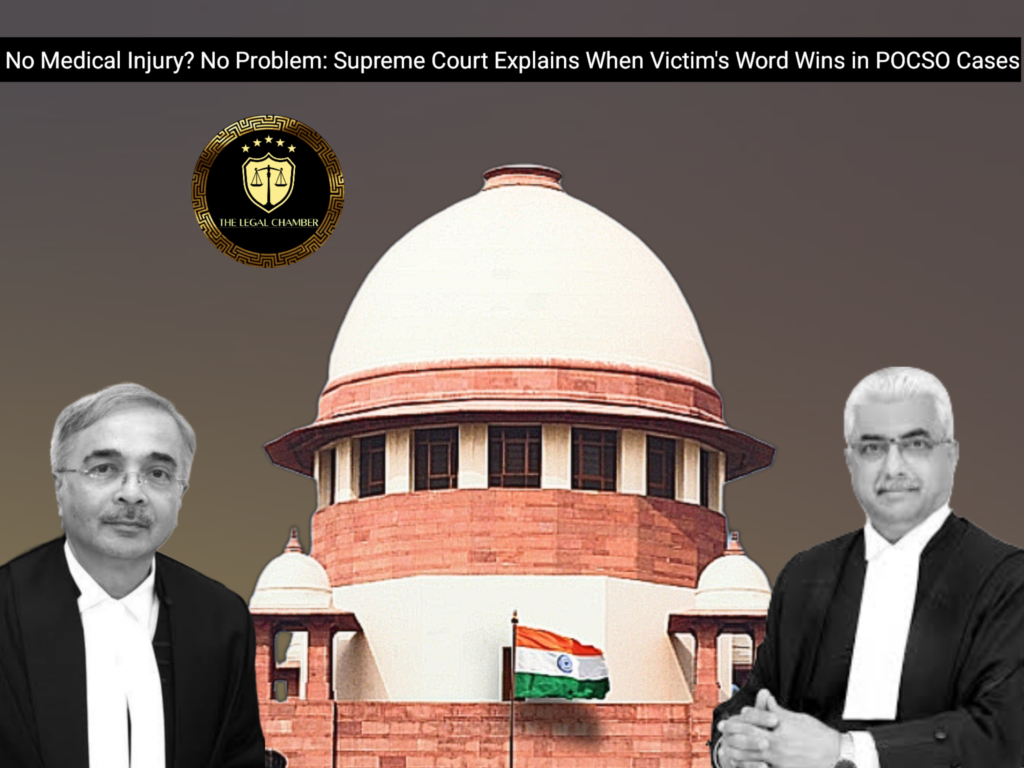
Judges/Justices: Justice N.V. Anjaria and Justice Aravind Kumar
Download The Judgement Here