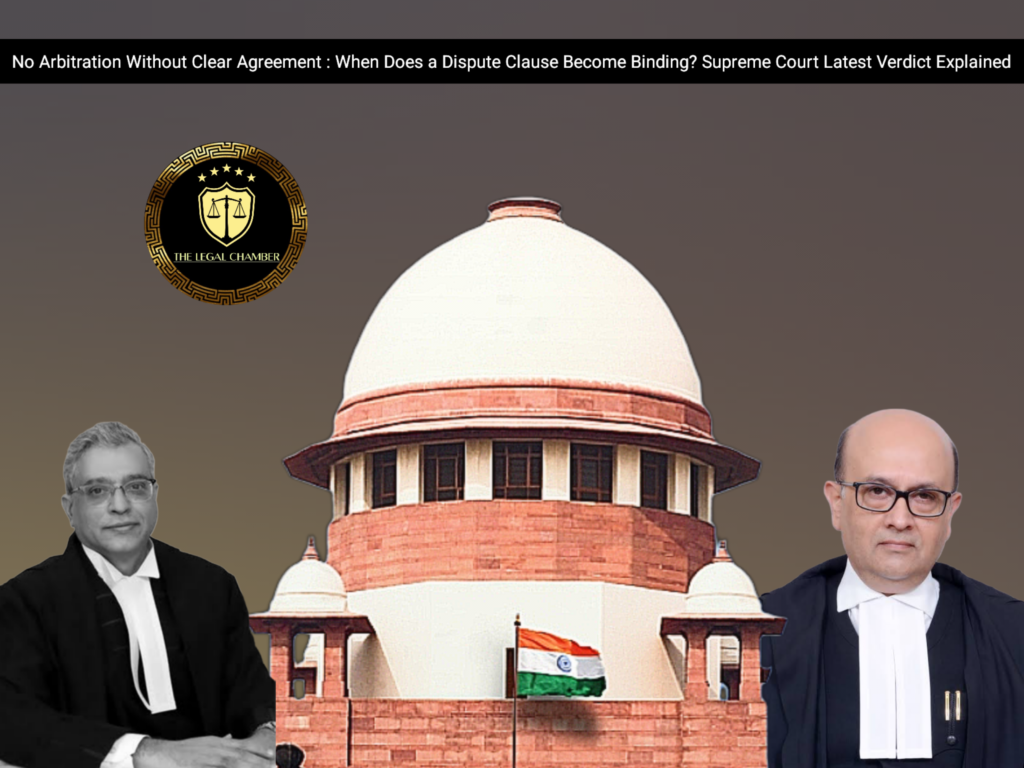
The Supreme Court held that Clause 13 of the contract, which stated disputes “may be sought through arbitration,” did not constitute a binding arbitration agreement under Section 7 of the Arbitration and Conciliation Act, 1996. The use of “may” indicated no mandatory intent to arbitrate, requiring further mutual consent. The Court emphasized that an arbitration agreement must reflect a clear, unequivocal commitment to resolve disputes through arbitration, excluding domestic courts. Mere enabling language without obligation is insufficient. The High Court’s dismissal of the arbitration application was upheld.
Facts Of The Case:
The dispute arose between BGM & M-RPL-JMCT (JV) (Appellant) and Eastern Coalfields Limited (Respondent) over a contract for transportation/handling of goods. The Appellant relied on Clause 13 of the General Terms and Conditions in the e-tender notice, which outlined a dispute resolution mechanism. This clause stated that disputes between non-government entities “may be sought through Arbitration and Conciliation Act, 1996,” but used the word “may” instead of a mandatory term like “shall.”When disputes emerged, the Appellant filed an application under Section 11(6) of the Arbitration Act for the appointment of an arbitrator. The Respondent objected, arguing that Clause 13 lacked a binding arbitration agreement since it only permitted—but did not compel—arbitration. The Calcutta High Court dismissed the application, ruling that the clause did not reflect a mutual intent to arbitrate.On appeal, the Supreme Court examined whether Clause 13 satisfied Section 7 of the Arbitration Act, which requires a clear agreement to arbitrate. The Court agreed with the High Court, holding that the permissive language (“may”) indicated no binding obligation to arbitrate unless parties later consented. Since no subsequent agreement existed, arbitration could not be enforced. The appeal was dismissed, reinforcing that arbitration clauses must explicitly exclude court jurisdiction to be valid.
Procedural History:
The case originated when BGM & M-RPL-JMCT (JV) (Appellant) filed an application under Section 11(6) of the Arbitration and Conciliation Act, 1996 before the Calcutta High Court, seeking the appointment of an arbitrator based on Clause 13 of their contract with Eastern Coalfields Limited (Respondent). The High Court dismissed the application, holding that the clause—which stated disputes “may be sought through arbitration”—did not constitute a binding arbitration agreement due to its permissive language.Aggrieved by this decision, the Appellant approached the Supreme Court via a Special Leave Petition (SLP), which was converted into a Civil Appeal after leave was granted. The Supreme Court examined whether the High Court erred in rejecting the arbitration application and whether Clause 13 met the requirements of Section 7 of the Arbitration Act. Ultimately, the Court upheld the High Court’s decision, ruling that the clause lacked mandatory intent to arbitrate and thus could not enforce arbitration unilaterally. The appeal was dismissed, reinforcing that clear and unequivocal language is essential for a valid arbitration agreement.
READ ALSO:Supreme Court Expunges Remarks Against Judicial Officer: Protects Subordinate Judiciary
Court Observation:
The Supreme Court made several key observations while dismissing the appeal. It emphasized that for a clause to qualify as an arbitration agreement under Section 7 of the Arbitration and Conciliation Act, 1996, it must demonstrate a clear and mandatory intention of parties to submit disputes to arbitration, excluding regular courts.The Court noted that Clause 13’s use of the word “may” instead of “shall” indicated only a permissive option for arbitration, not a binding obligation. It distinguished between clauses that compel arbitration versus those that merely enable it if parties later agree. The bench reaffirmed precedents like Jagdish Chander v. Ramesh Chander and Mahanadi Coalfields, which hold that tentative or conditional arbitration clauses lacking mutual commitment do not create enforceable arbitration rights.Additionally, the Court clarified that while Section 11 empowers courts to examine the existence of an arbitration agreement, they need only conduct a prima facie review at this stage. However, when a clause is patently non-binding (like Clause 13), courts can reject arbitration requests outright rather than leaving it for arbitral tribunals to decide. The judgment reinforces that arbitration agreements must be explicit in showing parties’ intent to be bound by arbitration exclusively.
Final Decision & Judgement:
The Supreme Court dismissed the appeal, upholding the Calcutta High Court’s decision that Clause 13 of the contract did not constitute a valid arbitration agreement under Section 7 of the Arbitration and Conciliation Act, 1996. The Court ruled that the permissive wording (“may be sought through arbitration”) demonstrated only a possibility of future arbitration rather than a binding obligation, thereby failing to meet the essential requirement of a mandatory arbitration clause.In its final judgment, the Court reinforced that arbitration agreements must use explicit language showing parties’ unequivocal intent to submit disputes to arbitration to the exclusion of courts. Since Clause 13 lacked such clarity and required further mutual consent, the Appellant could not unilaterally enforce arbitration. The bench declined to appoint an arbitrator, affirming that courts must reject arbitration requests when the alleged agreement is merely enabling rather than obligatory. No costs were awarded, and all pending applications were disposed of accordingly. The judgment serves as a precedent on the necessity of precise drafting in arbitration clauses to avoid ambiguity in dispute resolution mechanisms
Case Details:
Case Title:BGM & M-RPL-JMCT (JV) vs. Eastern Coalfields Limited
Citation:(2024) 6 SCC 1
Civil Appeal No.:(Arising out of SLP (C) Diary No. 21451/2024)
Date of Judgment:July 18, 2025
Judges/Justice Name: Justice Pamidighantam Sri Narasimha & Justice Manoj Misra
Download The Judgement Here