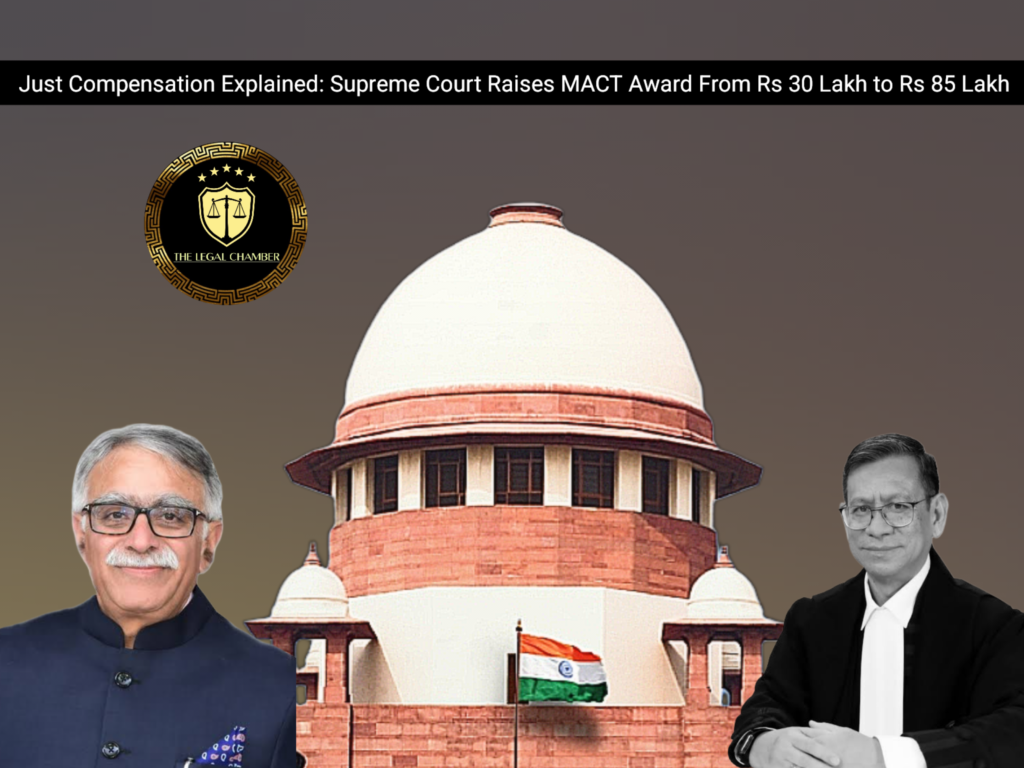
The Supreme Court enhanced compensation by applying established principles under the Motor Vehicles Act. It awarded amounts under non-pecuniary heads like marriage prospects and pain & suffering, and granted attendant charges for two attendants, citing precedents to ensure just and equitable restitution for the claimant’s 100% disability.
Facts Of The Case:
The claimant-appellant, Reshma, aged 24, suffered severe injuries in a motor vehicle accident on February 23, 2015, due to the rash and negligent driving of the offending vehicle, which was duly insured. The Motor Accidents Claims Tribunal (MACT) initially awarded compensation of ₹30,24,800, assessing her income at ₹10,000 per month and her disability at 100%. Dissatisfied, she appealed to the High Court, which enhanced the total compensation to ₹35,86,400 by reassessing her monthly income at ₹9,000 and adding 40% for future prospects. Still aggrieved, the claimant appealed to the Supreme Court, contending that the compensation was inadequate under several heads, including marriage prospects, disfigurement, attendant charges, future medical expenses, and pain and suffering, and sought interest at 12% per annum. The Supreme Court, acknowledging the life-altering nature of her injuries—85% mental disability and 45% physical disability to the lower left limb—substantially enhanced the award. It granted ₹4,00,000 for loss of marriage prospects, ₹43,20,000 for attendant charges for two attendants, and ₹5,00,000 for pain and suffering, among other enhancements, bringing the total compensation to ₹85,09,369.
Procedural History:
The procedural history of the case commenced with the filing of a claim petition (MVC No.1320/2016) before the XI Additional District & Sessions Judge & Additional MACT, Belagavi, which resulted in an award dated 04.12.2017. Dissatisfied with the compensation, the claimant-appellant preferred Miscellaneous First Appeal No.102764 of 2018 before the High Court of Karnataka at Dharwad, which, vide its order dated 24.09.2024, partly allowed the appeal by enhancing the compensation amount. Subsequently, the claimant-appellant sought special leave to appeal before the Supreme Court (SLP (C) No. 14729 of 2025), which was granted, leading to the present Civil Appeal. The Supreme Court, after hearing the parties, allowed the appeal and substantially modified the compensation award in its judgment dated 14.10.2025
READ ALSO:Supreme Court :Why Consent Doesn’t Matter If Victim Is Under 16
Court Observation:
The Supreme Court observed that the object of just compensation is to restore the claimant, as far as monetarily possible, to the position she would have been in had the accident not occurred, acknowledging the profound and permanent impact of her 100% disability. The Court emphasized that non-pecuniary heads like loss of marriage prospects and pain and suffering are integral to a holistic assessment of damages, even if not precisely quantifiable. It found the compensation for attendant charges awarded by the lower courts to be severely inadequate given the nature of the claimant’s grievous injuries, justifying the provision for two attendants based on precedent. The Court further held that the assessment of compensation must be liberal and purposive to address the catastrophic life-altering consequences suffered by the victim.
Final Decision & Judgement:
The Supreme Court allowed the appeal and substantially enhanced the total compensation payable to the claimant-appellant from ₹35,86,400 (as modified by the High Court) to ₹85,09,369. The enhanced amount included significant awards under the heads of attendant charges for two attendants (₹43,20,000), loss of marriage prospects (₹4,00,000), and pain and suffering (₹5,00,000), among others. The Court modified the impugned awards of the Tribunal and the High Court accordingly and directed that the enhanced compensation, along with interest as awarded by the High Court from the date of the original claim petition, be directly remitted to the claimant-appellant’s bank account by November 30, 2025. All pending applications were disposed of.
Case Details:
Case Title: Reshma vs. Dajiba Krishna Lad & Anr.
Civil Appeal No.: Civil Appeal No. of 2025 (Arising out of SLP (C) No. 14729 of 2025).
Date of Judgement: October 14, 2025.
Judges/Justice Names: Justice Sanjay Karol and Justice Nongmeikapam Kotiswar Singh