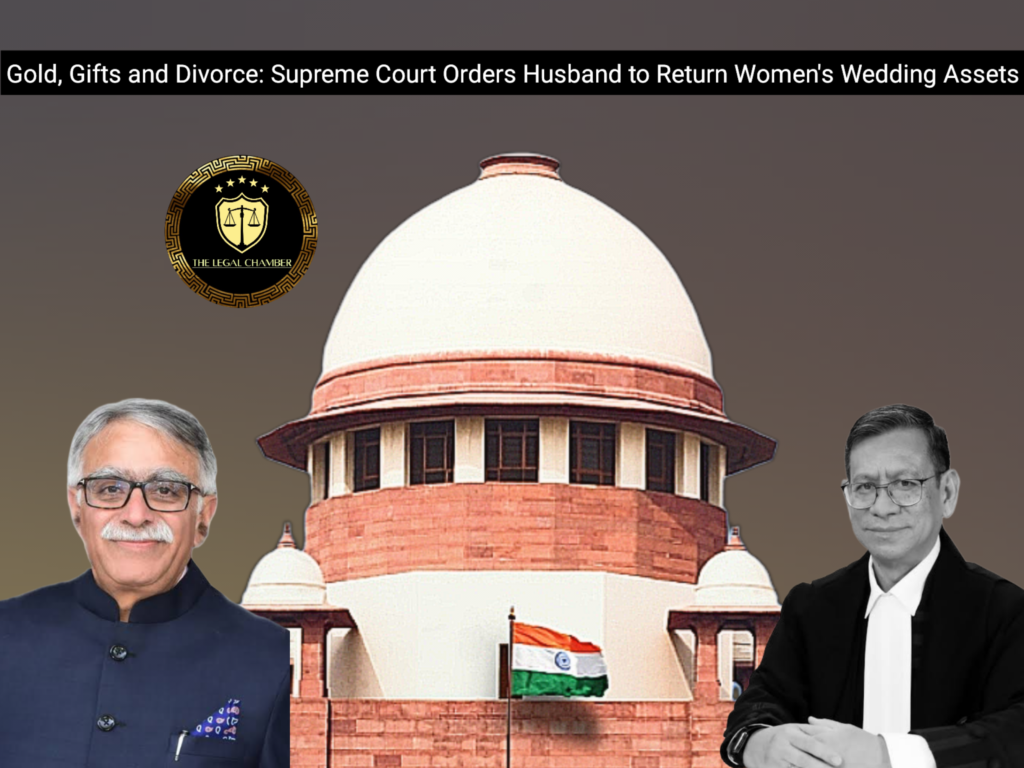
In this judgment, the Supreme Court held that property given to a bride at the time of marriage remains her entitlement post-divorce under Section 3 of the Muslim Women Act. The Court emphasized purposive interpretation to protect a woman’s dignity and financial security, prioritizing social justice over procedural discrepancies to ensure enforcement of her legal rights.
Facts Of The Case:
The marriage between the appellant, Rousanara Begum, and the respondent, S.K. Salahuddin, was solemnized on August 28, 2005. However, marital discord soon arose, leading the appellant to leave her matrimonial home on May 7, 2009. Following this separation, she initiated legal proceedings against her husband, including an application under Section 125 of the Code of Criminal Procedure, 1973, for maintenance and a criminal complaint under Section 498-A of the Indian Penal Code, 1860, which deals with cruelty by a husband or his relatives. The marriage ultimately ended in divorce on December 13, 2011. Subsequently, the appellant approached the court under Section 3 of The Muslim Women (Protection of Rights on Divorce) Act, 1986, seeking the return of her properties. She claimed a total of Rs. 17,67,980, which included a dower amount of Rs. 1,50,000, dowry of Rs. 7,00,000, 30 bhori (sovereigns) of gold ornaments valued at Rs. 9,00,000, and various household items such as a fridge, television, furniture, and bedding. The case saw multiple rounds of litigation, with the trial court initially awarding her Rs. 8.3 lakhs, a decision that was contested and remanded. Eventually, the High Court at Calcutta set aside the award, prompting the appellant to appeal to the Supreme Court.<|end▁of▁thinking|>The marriage between Rousanara Begum and S.K. Salahuddin was solemnized on 28th August 2005, but the couple separated on 7th May 2009 following the onset of marital differences. Subsequently, the appellant filed an application under Section 125 of the Code of Criminal Procedure, 1973 for maintenance and initiated criminal proceedings under Section 498-A of the Indian Penal Code, 1860 against her husband. The marriage ultimately ended in divorce on 13th December 2011. Thereafter, the appellant filed an application under Section 3 of The Muslim Women(Protection of Rights on Divorce) Act, 1986 before the Chief Judicial Magistrate seeking return of properties totaling Rs. 17,67,980/-, which included a dower amount of Rs. 1,50,000/-, dowry of Rs. 7,00,000/-, 30 bhori gold ornaments worth Rs. 9,00,000/-, and various household items such as a fridge, stabilizer, television, showcase, box bed, dressing table, steel almirah, sofa set, dining table, and bedding. The case traveled through multiple judicial forums, with the trial court initially allowing the application and granting Rs. 8.3 lakhs. Both parties preferred revision petitions, leading to a remand for fresh consideration. After further proceedings and revisions, the Additional Chief Judicial Magistrate framed three issues and awarded Rs. 8 lakhs along with 30 bhori gold ornaments. The respondent’s subsequent revision was dismissed by the Sessions Court, but the High Court at Calcutta, in a petition under Article 227 of the Constitution, set aside the lower courts’ orders, leading to the present appeal before the Supreme Court.
Procedural History:
The procedural history of Rousanara Begum v. S.K. Salahuddin began when the appellant filed an application under Section 3 of The Muslim Women (Protection of Rights on Divorce) Act, 1986, before the Chief Judicial Magistrate (CJM), Bolpur, seeking the return of various gifts and dowry items . The Learned CJM partially allowed her claim on 26th June 2014, awarding Rs. 8.3 lakhs . Both parties filed revision petitions before the Sessions Judge, who remanded the matter for a fresh trial to permit the marriage registrar’s evidence . Upon remand, the Additional Judicial Magistrate again ruled in favor of the appellant on 23rd February 2015, granting Rs. 8 lakhs and 30 bhories of gold . The respondent’s revision against this order was allowed by the Additional Sessions Judge on 21st July 2015, leading to a second remand for additional evidence .Subsequently, the Additional Chief Judicial Magistrate (ACJM), Bolpur, on 27th April 2017, after examining the evidence including the marriage register entries (Exhibits 7 and 8), held the respondent liable to return Rs. 7 lakhs and the 30 bhories of gold to the appellant . The respondent’s Criminal Revision No. 21 of 2017 was dismissed by the Court of Sessions on 15th December 2018, which found no irregularity in the ACJM’s order . Aggrieved, the respondent approached the Calcutta High Court under Article 227 of the Constitution of India . The High Court, by its judgment dated 24th November 2022 and order dated 31st January 2024, allowed the petition and set aside the orders of the lower courts, primarily relying on a statement made by the appellant’s father in the separate Section 498A IPC proceedings . It was against this final order of the High Court that the appellant approached the Supreme Court by way of a Special Leave Petition
READ ALSO:Compromise Between Parties Leads to Early Release as Supreme Court Modifies Sentence in Criminal Appeal
Court Observation:
The Supreme Court observed that the High Court erred in its reasoning by giving undue weight to the father’s statement made during Section 498-A proceedings, especially since those proceedings had resulted in the respondent’s acquittal, which had attained finality. The Court noted that the marriage registrar’s testimony regarding discrepancies in the marriage register entries was supported by documentary evidence and should have been accepted. The Court emphasized that the 1986 Act must be interpreted purposively to secure the dignity and financial protection of Muslim women post-divorce, aligning with their rights under Article 21 of the Constitution. It further observed that courts must ground their reasoning in social justice adjudication, keeping equality, dignity, and autonomy at the forefront, particularly considering the lived experiences of women in smaller towns and rural areas where patriarchal discrimination remains prevalent. The Court expressed difficulty in agreeing with the High Court’s approach of treating the matter purely as a civil dispute while missing the purposive construction goalpost of the legislation.
Final Decision & Judgement:
The Supreme Court allowed the appeals filed by Rousanara Begum and set aside the judgment and order passed by the Calcutta High Court. The Court held that properties given to a daughter at the time of her marriage by her father, whether given to her directly or to the bridegroom, are legally returnable to her after divorce under Section 3 of The Muslim Women (Protection of Rights on Divorce) Act, 1986. The Court directed the respondent to remit the awarded amount directly into the appellant’s bank account, with the appellant’s counsel required to provide the necessary bank details within three working days from the date of judgment. The respondent was directed to file an affidavit of compliance with the Supreme Court Registry within six weeks thereafter. The Court further stipulated that if the respondent failed to comply with the direction, he would be liable to pay interest at the rate of 9% per annum on the awarded amount. All pending applications, if any, stood disposed of by this final order.
Case Details:
Case Title: Rousanara Begum v. S.K. Salahuddin @ Sk Salauddin & Anr.
Citation: 2025 INSC 1375
Criminal Appeal No.: (Arising out of SLP(Crl.) No(s)........... of 2025) (@ Diary No.60854 of 2024)
Date of Judgment: December 02, 2025
Judges/Justice Name: Justice Sanjay Karol and Justice Nongmeikapam Kotiswar Singh
Download The Judgement Here