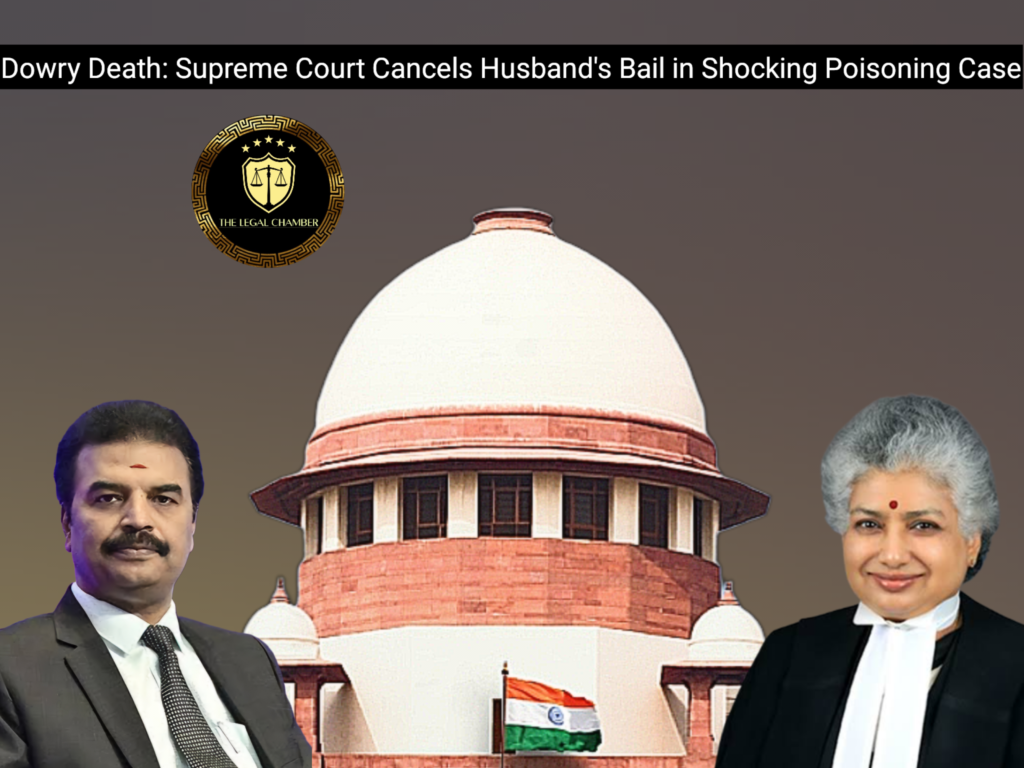
The Supreme Court annulled the bail granted to a husband accused of dowry death, holding that the High Court erred by ignoring the statutory presumption under Section 113B of the Evidence Act and the gravity of offences under Sections 304B and 498A IPC. Bail orders ignoring material evidence and established legal principles are perverse and liable to be set aside.
Facts Of The Case:
The appellant’s daughter was married to the first respondent on 22.02.2023. Within four months of the marriage, on 05.06.2023, she died under suspicious circumstances after allegedly being forced to consume a poisonous substance. Prior to her death, she had complained to her family about persistent harassment and a demand for a Fortuner car as additional dowry by her husband and his relatives. On the night of the incident, she made a distressed phone call to her sister, stating that her husband and his relatives had forcibly administered a foul-smelling substance to her. A post-mortem examination revealed an ante-mortem abrasion on her forearm, and a subsequent forensic report confirmed the presence of aluminium phosphide poison in her viscera. Despite these allegations, a chargesheet was filed only against the husband, and he was granted bail by the High Court, leading the victim’s father to appeal to the Supreme Court for its cancellation.
Procedural History:
The case originated with the registration of FIR No. 415 of 2023 on June 15, 2023, at Police Station Kotwali, District Fatehpur, Uttar Pradesh, against the respondent-husband and his family members for offences under Sections 498A, 304B, 120B, and 328 IPC, read with Sections 3 and 4 of the Dowry Prohibition Act. Upon completion of the investigation, a chargesheet was filed only against the respondent-husband on October 30, 2023. The respondent first sought bail before the Sessions Court, which rejected his application (Bail Application No. 2225 of 2023) on October 20, 2023. Aggrieved, he approached the High Court of Judicature at Allahabad by filing Criminal Misc. Bail Application No. 7768 of 2024. The High Court allowed his bail application on January 9, 2025. Challenging this order, the appellant, being the father of the deceased and the original complainant, filed a Special Leave Petition before the Supreme Court of India. The Supreme Court granted leave on November 28, 2025, and treated the petition as a criminal appeal, ultimately allowing the appeal and setting aside the High Court’s bail order.
READ ALSO:Can a Creditor Attach Property Already Sold? Supreme Court Clarifies the Law
Court Observation:
The Supreme Court observed that the High Court failed to consider the gravity of the offence and the statutory presumption under Section 113B of the Evidence Act, which mandates a presumption of dowry death once foundational facts are established. The Court noted that the marriage took place on 22.02.2023 and the death occurred on 05.06.2023, i.e., within four months, and the dying declarations to the father and elder sister, coupled with consistent witness testimony and the post-mortem noting of an abrasion suggestive of restraint, satisfied the requirements of Section 304B IPC. The Court further observed that the High Court erroneously relied on general bail principles while ignoring the legislative intent behind dowry death provisions, which reflect the firm resolve to combat the social evil of dowry. It was also noted that the investigating agency remained inactive for an inordinate period, as the accused was arrested only after 104 days from lodging the FIR, reflecting serious lapses in investigation. The Court emphasized that dowry death is not merely an offence against an individual but a crime against society at large, and judicial passivity or misplaced leniency would embolden perpetrators and undermine public confidence in the justice delivery system. The Court further observed that the presumption under Section 113B is a presumption of law, and once the prosecution establishes that the death occurred otherwise than under normal circumstances within seven years of marriage and that the deceased was subjected to cruelty or harassment soon before her death in connection with dowry demand, the burden shifts to the accused to rebut this presumption.
Final Decision & Judgement:
The Supreme Court allowed the criminal appeal, setting aside the impugned order of the High Court that had granted bail to the respondent-accused. The Court cancelled the bail and directed the respondent to surrender to custody forthwith, with a further direction that if he failed to do so, the concerned authorities would take him into custody immediately. The Court clarified that its judgment was confined to the issue of cancellation of bail and that the trial against the respondent would proceed independently, on its own merits, and strictly in accordance with law. The Court also disposed of all connected miscellaneous applications.
Case Details:
Case Title: Yogendra Pal Singh v. Raghvendra Singh Alias Prince and Another
Citation: 2025 INSC 1367
Criminal Appeal No.: Criminal Appeal arising out of SLP (Crl.) No. 8075 of 2025
Date of Judgment: November 28, 2025
Judges/Justice Name: Justice R. Mahadevan and Justice B.V. Nagarathna
Download The Judgement Here