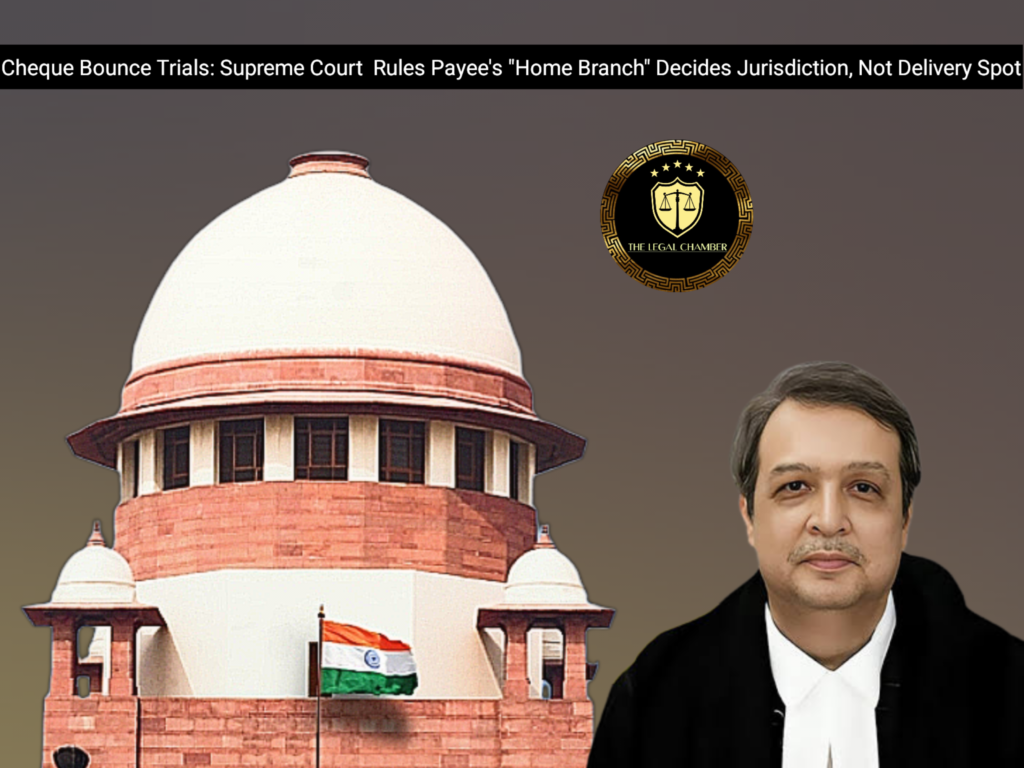
This Supreme Court judgment clarifies that for cheque bounce cases involving account payee cheques, territorial jurisdiction lies exclusively with the court where the payee’s home branch (where the account is maintained) is situated, not where the cheque was physically delivered. It overrules prior conflicting interpretations, holding that the amended Section 142(2)(a) governs jurisdiction over general procedural laws.
Facts Of The Case:
The dispute originated from a cheque for ₹19,94,996/- drawn by the accused company (Jai Balaji Industries Ltd.) on its Kolkata-based bank (State Bank of Bikaner and Jaipur) in favor of the complainant (M/s HEG Limited). The complainant deposited this cheque on June 19, 2014, at its account maintained with the State Bank of India, Bhopal branch. The cheque was dishonoured on June 20, 2014, due to insufficient funds. Following the statutory notice and the accused’s failure to pay, the complainant initially filed Complaint Case No. 406978 of 2014 before the Metropolitan Magistrate, Kolkata, on August 16, 2014.While the Kolkata court was seized of the matter and had progressed to the stage of recording evidence under Section 145(2) of the Negotiable Instruments Act, the Negotiable Instruments (Amendment) Act, 2015 was enacted. This amendment introduced new provisions regarding territorial jurisdiction. Based on a request by the complainant, the MM, Kolkata, vide order dated July 28, 2016, returned the complaint, observing that it lacked jurisdiction. Consequently, the complainant refiled the complaint before the Judicial Magistrate First Class, Bhopal, where it was registered as Complaint Case No. RCT 1501046 of 2017. The accused challenged the jurisdiction of the Bhopal court, leading to the present transfer petition before the Supreme Court seeking to transfer the case back to Kolkata.
Procedural History:
The procedural history began when the complainant initially filed the cheque dishonour case before the Metropolitan Magistrate, Kolkata, on August 16, 2014. The Kolkata court took cognizance, issued summons on January 29, 2015, framed charges, and by April 27, 2015, had taken the complainant’s affidavit evidence on record, thereby reaching the stage of evidence under Section 145(2) of the Negotiable Instruments Act.Following the enactment of the Negotiable Instruments (Amendment) Act, 2015, which altered the territorial jurisdiction provisions, the complainant requested the MM, Kolkata to return the complaint. On July 28, 2016, the Kolkata court complied, returning the complaint on the ground that it lacked jurisdiction. The complainant thereafter presented the complaint before the Judicial Magistrate First Class, Bhopal, where it was registered in 2017. The accused raised objections to the Bhopal court’s territorial jurisdiction, which were rejected by the JMFC. The accused then challenged this rejection through a Criminal Revision petition before the Sessions Court, Bhopal, which remained pending.Aggrieved by the continuation of proceedings in Bhopal, the accused approached the Supreme Court by filing Transfer Petition (Criminal) No. 1099 of 2025 under Section 406 of the BNSS, seeking transfer of the complaint from Bhopal back to Kolkata. Four connected transfer petitions involving similar issues were heard together, with the Supreme Court disposing them all through this common judgment.
READ ALSO:Dowry Death: Supreme Court Cancels Husband’s Bail in Shocking Poisoning Case
Court Observation:
The Supreme Court made several critical observations while interpreting the jurisdictional scheme under the amended Negotiable Instruments Act. The Court observed that prior to the 2015 Amendment, the position of law regarding territorial jurisdiction was complex and had evolved through various judgments. It analyzed the trajectory from K. Bhaskaran v. Sankaran Vaidhyan Balan, which permitted filing at any place where any of the five acts constituting the offence occurred, to Harman Electronics (P) Ltd. v. National Panasonic India (P) Ltd., which restricted this by holding that notice receipt, not mere issuance, determined jurisdiction. The Court further observed that in Dashrath Rupsingh Rathod v. State of Maharashtra, a three-Judge Bench had localized the offence at the place where the drawee bank dishonoured the cheque, finding the earlier broad approach prone to abuse.The Court observed that the Amendment Act, 2015, specifically Section 142(2), was enacted to override the restrictive interpretation in Dashrath Rupsingh and provide clarity. It observed that Section 142(2)(a) applies to cheques delivered for collection through an account, i.e., account payee cheques, while Section 142(2)(b) applies to bearer cheques presented otherwise. The Court critically observed that the Explanation to Section 142(2)(a) creates a legal fiction: when a cheque is delivered for collection at any branch of the payee’s bank, it shall be deemed to have been delivered to the branch where the payee maintains the account—the “home branch.” Therefore, the Court observed that territorial jurisdiction is anchored exclusively at the place where the payee’s home branch is situated, not where the physical delivery occurred.The Court further observed that the interpretation in Yogesh Upadhyay v. Atlanta Ltd., which gave primacy to the place of physical delivery, was per incuriam as it ignored this deeming fiction and would permit forum shopping. The Court observed that the legislature could not have intended to allow payees to manipulate jurisdiction by choosing where to deliver cheques. Applying these observations to the present case, the Court observed that since the complainant maintained its account in Bhopal, the JMFC, Bhopal possessed exclusive jurisdiction. However, the Court also observed that since the Kolkata court had already reached the evidence stage before returning the complaint, transferring the case back to Kolkata would meet the ends of justice, consistent with the savings provision in Dashrath Rupsingh.
Final Decision & Judgement:
The Supreme Court allowed the transfer petitions and issued a comprehensive judgment resolving the jurisdictional ambiguity under the amended Negotiable Instruments Act. The Court held that under Section 142(2)(a), for account payee cheques delivered for collection through an account, territorial jurisdiction vests exclusively in the court within whose local limits the branch of the bank where the payee or holder in due course maintains the account—the “home branch”—is situated. The Court clarified that the Explanation to Section 142(2)(a) creates a binding legal fiction whereby delivery of a cheque at any branch of the payee’s bank is deemed to be delivery at the home branch for jurisdictional purposes, thereby preventing complainants from manipulating jurisdiction by choosing where to physically deliver cheques.Applying this principle to the facts, the Court determined that the Judicial Magistrate First Class, Bhopal, possessed exclusive jurisdiction to try the complaint since the complainant maintained its account with the State Bank of India, Bhopal branch. Consequently, the Metropolitan Magistrate, Kolkata, correctly returned the complaint for lack of jurisdiction. However, taking note of the procedural history, the Court observed that the Kolkata court had already progressed to the stage of recording evidence under Section 145(2) of the Act before returning the complaint on July 28, 2016. Relying on the savings provision articulated in Dashrath Rupsingh Rathod, which permitted cases that had reached the evidence stage to continue in the same court, the Supreme Court directed that the complaint be transferred back to the Metropolitan Magistrate, Kolkata. The Court ordered that proceedings resume from the stage immediately prior to the order returning the complaint, thereby protecting the evidentiary record already compiled. All connected transfer petitions were disposed of in the same terms, and the Court directed its Registry to forward copies of the judgment to all High Courts for guidance.
Case Details:
Case Title: Jai Balaji Industries Ltd. and Ors. v. M/s HEG Ltd.
Citation: 2025 INSC 1362
Criminal Appeal/Transfer Petition No.: Transfer Petition (Crl.) No. 1099 of 2025
Date of Judgment: November 28, 2025
Judges/Justice Name: Justice J.B. Pardiwala
Download The Judgement Here