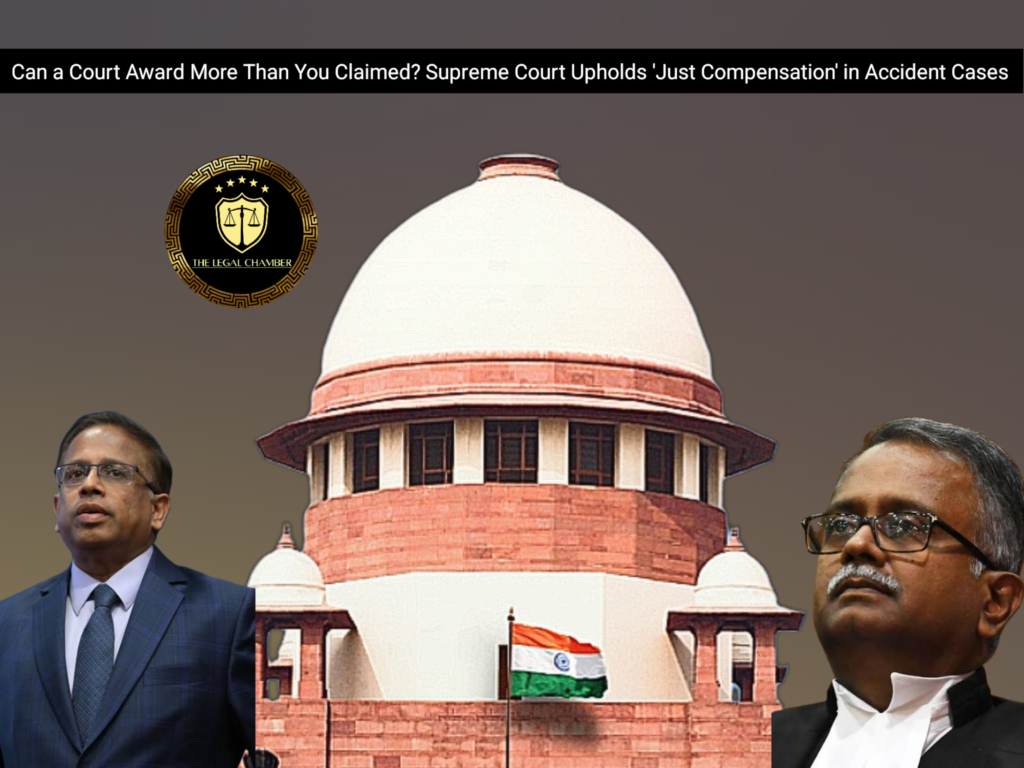
The Supreme Court allowed the appeal in part, holding that tribunals can award compensation exceeding the claimed amount under the Motor Vehicles Act to ensure just and fair relief. It emphasized adding future prospects to monthly income for calculating loss of earnings due to functional disability. The Court also granted a lump sum for attendant care based on the claimant’s age and injuries.
Facts Of The Case:
On 26.01.2012, the appellant, R. Logeshkumar, aged 21, was riding a motorcycle from Selaiyur to Medavakkam in Chennai. At the Kamarajapuram junction, a jeep owned by the first respondent and insured by the second respondent came from the opposite direction in a rash and negligent manner, without sounding a horn, and collided with his motorcycle. The accident caused grievous injuries to the appellant, including head injuries, brain damage, and hemiparesis, leading to significant physical impairment and disability. At the time of the accident, he was working as an accounts assistant and claimed to earn a monthly salary of Rs. 9,000. He filed a claim petition before the Motor Accidents Claims Tribunal seeking compensation of Rs. 15,00,000. The Tribunal awarded him Rs. 3,98,017. Dissatisfied with this amount, the appellant filed an appeal before the Madras High Court for enhancement of compensation. The High Court, after assessing the evidence, particularly the oral testimony of the treating doctors regarding the extent of disability, enhanced the compensation to Rs. 14,65,617 by fixing his monthly income at Rs. 6,500 and applying 100% functional disability. Still seeking further enhancement, the appellant approached the Supreme Court.
Procedural History:
The claim for compensation originated with the filing of MCOP No. 2672 of 2013 by the appellant before the Motor Accidents Claims Tribunal (III Small Causes, Chennai). The Tribunal partially allowed the claim and awarded a sum of Rs. 3,98,017/- with interest at 7.5% per annum. Aggrieved by the quantum of compensation, the appellant preferred an appeal for enhancement before the Madras High Court in CMA (MD) No. 3343 of 2014. The High Court, upon re-evaluating the evidence, allowed the appeal in part and enhanced the compensation to Rs. 14,65,617/-. Still dissatisfied with the awarded amount, the appellant approached the Supreme Court by filing a Special Leave Petition, which was subsequently converted into the present Civil Appeal. The Supreme Court, after hearing both parties, allowed the appeal in part and further enhanced the compensation to Rs. 21,75,681/-.
READ ALSO:Commercial Contracts & Interest Rates: Supreme Court Reaffirms ‘Party Autonomy’ Over ‘Public Policy’
Court Observation:
The Supreme Court made several key observations while adjudicating the appeal. The Court observed that under the Motor Vehicles Act, 1988, there is no restriction on tribunals in awarding compensation exceeding the claimed amount, and the primary function of the tribunal is to award just compensation which is reasonable based on the evidence produced on record. Taking note of the appellant’s age (21 years) at the time of the accident and the severity of injuries including hemiparesis and brain damage, the Court observed that he cannot be expected to live independently, warranting a reasonable attendant allowance. Regarding the claim for reimbursement of medical expenses, the Court observed that the appellant failed to bring evidence before the Tribunal regarding these expenses, and the evidence introduced as additional evidence before the High Court was rightly not accepted. The Court further observed that the probable loss of monthly income should factor in future prospects, and accordingly added one-third of the salary towards future loss of income, fixing the monthly income at Rs. 8,667/-. Considering the totality of circumstances, the Court observed that a just and fair compensation must account for both the loss of earnings due to functional disability and the requirement of a personal attendant.
Final Decision & Judgement:
The Supreme Court delivered its judgment on December 5, 2025, partly allowing the civil appeal filed by the claimant. The Court set aside the compensation awarded by the High Court and redetermined the total compensation payable to the appellant at Rs. 21,75,681/-, which included a significant enhancement under two primary heads. The Court added one-third of the salary towards future prospects, increasing the monthly income for calculation purposes from Rs. 6,500 to Rs. 8,667, and recalculated the loss of earnings due to functional disability as Rs. 16,64,064/-. Additionally, considering the appellant’s age and the severity of his injuries requiring personal care, the Court enhanced the attendant charges from a meager Rs. 6,000 to a lump sum of Rs. 3,00,000/-. The Court, however, rejected the claim for reimbursement of additional medical expenses due to lack of evidence. The difference amount payable, over and above what had already been paid, was directed to carry interest at 7.5% per annum from the date of filing the claim petition. The appellant was directed to deposit the deficit court fee before the Tribunal within six weeks, and no order was made as to costs.
Case Details:
Case Title: R. Logeshkumar v. P. Balasubramaniam and Another
Citation: 2025 INSC 1392
Civil Appeal Nos.:  (@ S.L.P.(C) Nos. 4845 of 2025)
Date of Judgment: December 5, 2025
Judges/Justice Names: Justice K.V. Viswanathan and Justice S.V.N. Bhatti
Download The Judgement Here