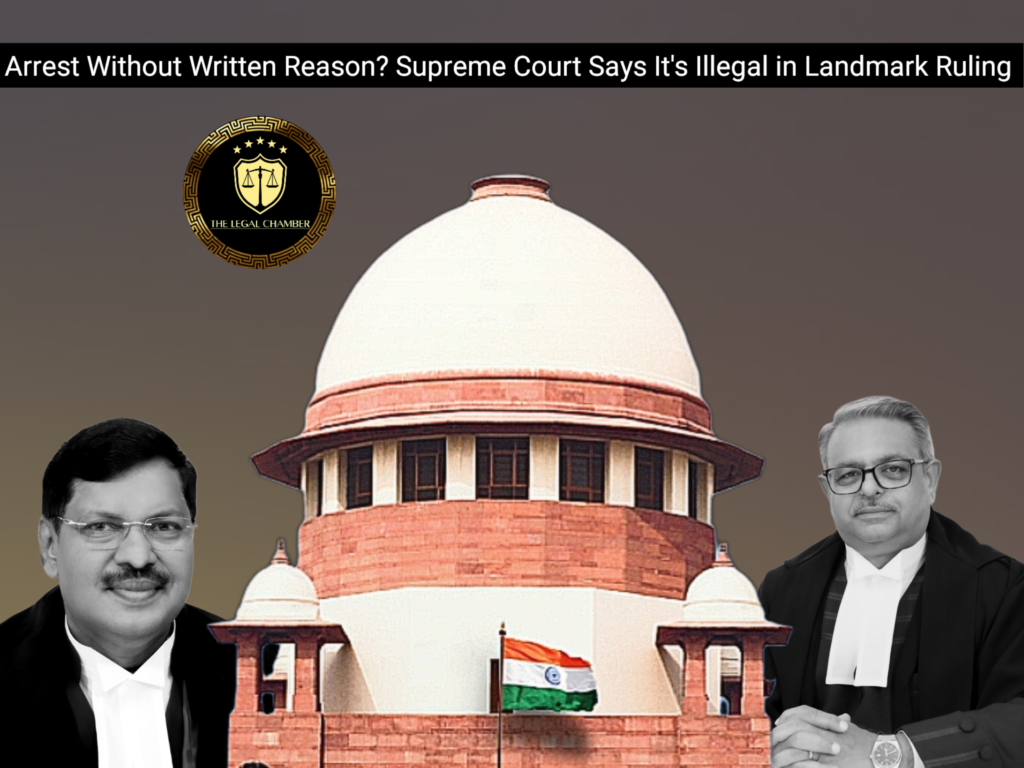
The procedural history of this case commenced with the registration of FIR No. 378/2024 at Worli Police Station following the fatal accident on July 7, 2024. After his arrest on July 9, the appellant, Mihir Rajesh Shah, was produced before the Judicial Magistrate First Class for remand, where he first contested the legality of his arrest on the grounds of not being furnished written reasons. This challenge was subsequently taken to the Bombay High Court via Criminal Writ Petition No. 3533 of 2024. The High Court, in its judgment dated November 25, 2024, acknowledged the procedural lapse but upheld the arrest’s validity. The appellant then filed a Special Leave Petition before the Supreme Court. The Supreme Court, vide order dated April 22, 2025, granted leave and framed specific questions of law for determination, leading to the present appeals being decided by this common judgment which settles the legal position on the mandatory requirement of furnishing written grounds of arrest.
READ ALSO:Supreme Court Sets Aside Quashing of Dowry Case, Reiterates Limits of High Court’s Power
Court Observation:
In its observations, the Supreme Court emphasized that the mandate under Article 22(1) of the Constitution is a fundamental, non-negotiable safeguard intended to equip an arrested person with the knowledge necessary to effectively seek legal counsel, oppose remand, and apply for bail. The Court clarified that the requirement to inform of the grounds of arrest applies uniformly to all offences, including those under the BNS 2023 (formerly IPC), and is not confined to special statutes like PMLA or UAPA. Crucially, the Court held that to serve this constitutional purpose meaningfully and avoid factual disputes, the communication of grounds must ordinarily be in writing, in a language understood by the arrestee. However, recognizing practical exigencies, it carved out a narrow exception for exceptional circumstances—such as offences committed in flagrante delicto—where oral intimation at the time of arrest suffices, provided a written copy is furnished within a reasonable time and in any case at least two hours before the accused is produced before a magistrate for remand. Non-compliance with this framework would render the arrest and subsequent remand illegal.
Final Decision & Judgement:
The Supreme Court allowed the appeals in part, setting a definitive legal framework for the future. It held that the constitutional mandate under Article 22(1) requires the grounds of arrest to be furnished in writing, in a language the arrestee understands, for all offences without exception, to make the right meaningful. However, in exceptional circumstances like an offence being committed in front of a police officer, oral communication at the time of arrest is permissible. In such cases, the written grounds must be supplied within a reasonable time and mandatorily at least two hours before the accused is produced before a magistrate for remand. Any arrest failing to comply with this procedure would be rendered illegal. Consequently, in the present case, the appellants who were already granted interim bail were directed to remain on bail, with liberty for the prosecution to seek fresh remand after complying with the newly outlined procedure.
Case Details:
Case Title: MIHIR RAJESH SHAH vs. STATE OF MAHARASHTRA AND ANOTHER
Citation: 2025 INSC 1288
Criminal Appeal No.: Criminal Appeal No. 2195 of 2025
Date of Judgement: November 06, 2025
Judges/Justice Name: Justice B.R. GAVAI & Justice AUGUSTINE GEORGE MASIH