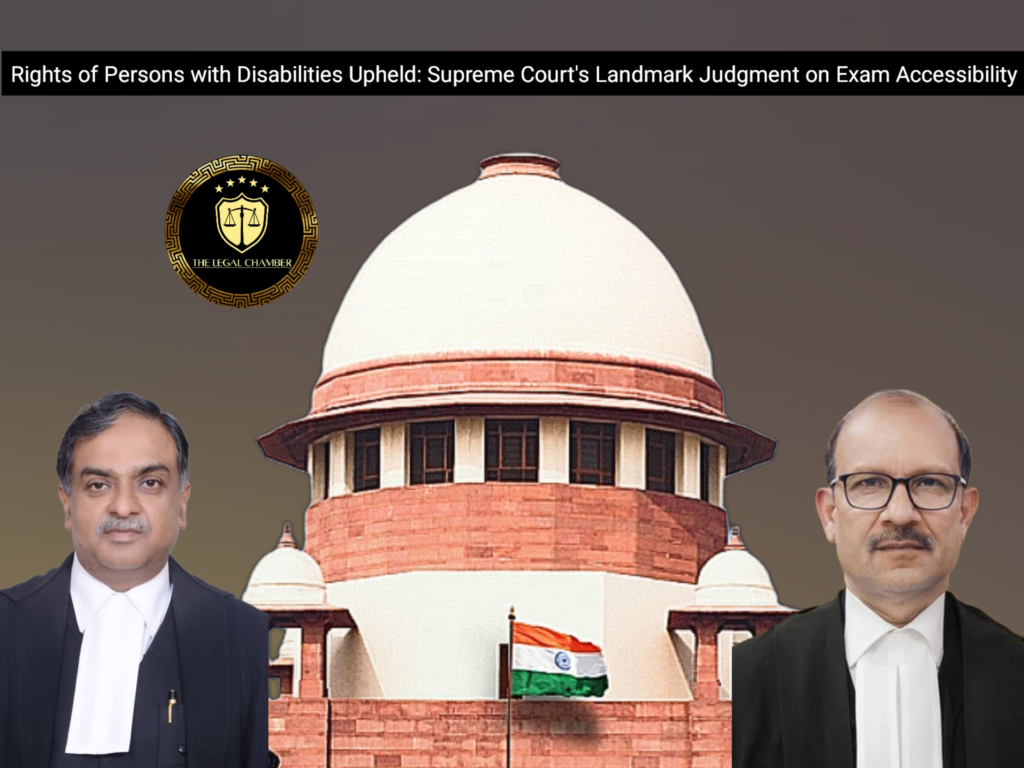
In this judgment, the Supreme Court affirmed that the constitutional guarantee of equality under Articles 14 and 21, read with the Rights of Persons with Disabilities Act, 2016, mandates substantive inclusion, not mere formal equality. The Court directed the UPSC to implement accessible examination processes, including screen reader software and flexible scribe registration, ensuring that rights for persons with disabilities are enforceable realities.
Facts Of The Case:
The writ petition was instituted by Mission Accessibility, an organization dedicated to advancing the rights of persons with disabilities, seeking enforcement of their rights under the Constitution of India and the Rights of Persons with Disabilities Act, 2016. The primary grievances pertained to the Civil Services Examination conducted by the Union Public Service Commission (UPSC). The petitioner challenged the requirement compelling visually impaired candidates to furnish scribe details at the time of application submission, arguing this inflexible timeline was arbitrary and unreasonable. Additionally, the petition sought directions for permitting eligible candidates to use laptops equipped with Screen Reader Software along with accessible digital question papers during the examination. During the proceedings, the UPSC filed affidavits addressing these concerns. It assured the Court that requests from Persons with Benchmark Disabilities (PwBD) for change of scribe would be considered on merit. Regarding the screen reader facility, the UPSC communicated its in-principle decision to introduce this assistive technology for visually impaired candidates in its examinations. However, the Commission acknowledged that the necessary infrastructure for its implementation was not immediately in place due to its dependence on external examination centers, leaving the timeline for operationalizing this facility uncertain.
Procedural History:
The case originated as a Writ Petition under Article 32 of the Constitution of India, filed directly before the Supreme Court of India in its Civil Original Jurisdiction. Upon the initial hearing on May 6, 2025, the Court impleaded the Department of Personnel and Training (DoPT) as a necessary party and directed the UPSC to file an affidavit regarding the change of scribe. Pursuant to this, the UPSC filed an affidavit on May 9, 2025, addressing the scribe modification requests but remaining silent on the screen reader issue. Subsequently, on May 9, 2025, the Court heard further submissions and directed the UPSC to entertain all scribe change requests until May 18, 2025, and to file a specific affidavit clarifying its position on the use of computers with screen readers. In compliance, the UPSC filed an additional affidavit on September 12, 2025, wherein it announced its in-principle decision to introduce Screen Reader Software but cited infrastructural limitations for its immediate implementation. After hearing final arguments on October 31, 2025, where the petitioner expressed satisfaction with the policy decision but sought a concrete implementation plan, the Court proceeded to dispose of the writ petition on December 3, 2025, by issuing comprehensive directions to ensure the operationalization of the facilitative measures.
READ ALSO:Gold, Gifts, and Divorce: Supreme Court Orders Husband to Return Woman’s Wedding Assets
Court Observation:
The Supreme Court made profound observations regarding the nature of equality and inclusion in a just society, emphasizing that true equality demands the removal of barriers that prevent individuals from standing on equal footing rather than mere uniformity. The Court observed that the Constitution envisions a Republic where every person, regardless of physical or sensory limitations, can participate with dignity in the nation’s collective journey, and that the law must move beyond formal equality to ensure substantive inclusion, transforming rights from written promises into lived realities. The Court noted that the rights guaranteed to persons with disabilities are not acts of benevolence but expressions of the constitutional promise of equality, dignity, and non-discrimination enshrined in Articles 14, 19, and 21 of the Constitution. It further observed that the true measure of inclusivity in governance lies not merely in the formulation of progressive policies but in their faithful and effective implementation. The Court acknowledged that while the UPSC had taken a conscious progressive decision to extend screen reader facilities, the absence of a clearly delineated roadmap underscored the need for institutional coordination and phased execution to ensure that the laudable objective of accessibility does not remain confined to paper but is translated into practical reality.
Final Decision & Judgement:
Case Details:
Case Title: Mission Accessibility v. Union of India & Ors.
Citation: 2025 INSC 1376
Case Number: Writ Petition (Civil) No(s). 206 of 2025
Date of Judgment: December 03, 2025
Judges/Bench: Justice Vikram Nath and Justice Sandeep Mehta
Download The Judgement Here