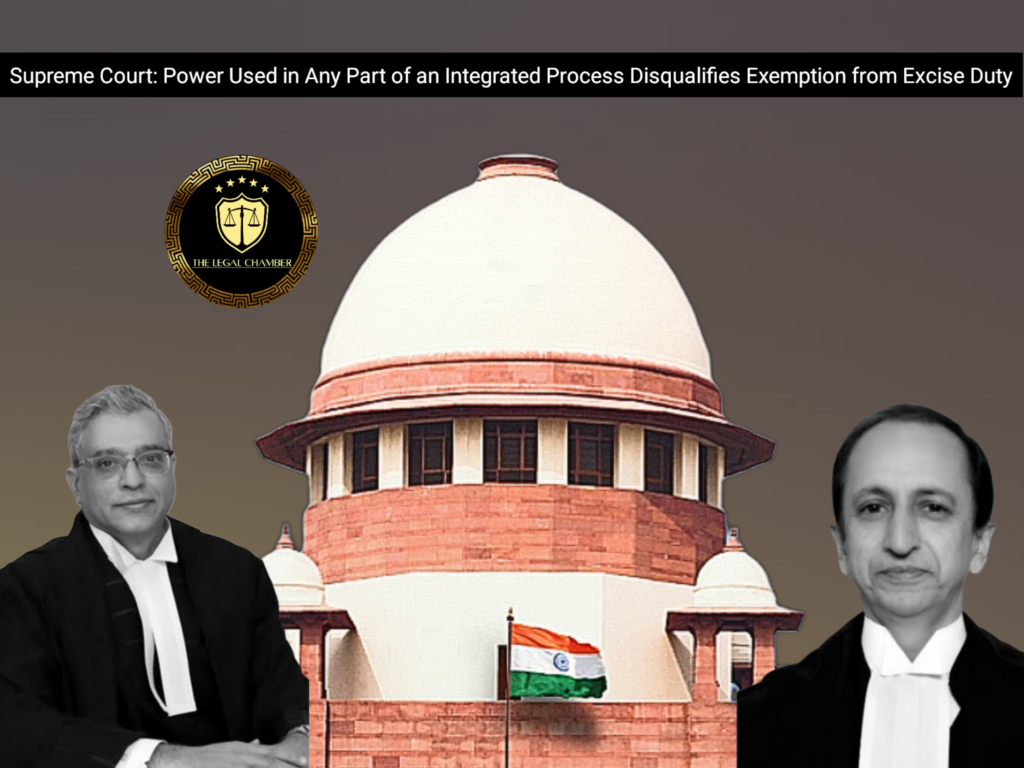
The Supreme Court held that “manufacture” includes a series of integrally connected processes. For exemption eligibility, the cumulative effect of all processes—even across different units—must be considered. If any integral process uses power, the entire manufacture is deemed to be with power, disentitling the final product from exemption.
Facts Of The Case:
The appellant-department received intelligence that Bhagyalaxmi Processor Industry (Unit 1) and Famous Textile Packers (Unit 2) were processing cotton fabrics with power without following excise procedures. A search on 21.01.2003 revealed both units operated within the same compound and possessed industrial electricity connections with machinery like mercerizing, bleaching, squeezing, and stentering machines operated by electric motors. Investigations suggested Unit 1 received grey fabric for bleaching and mercerizing, transferred the wet fabric to Unit 2 for squeezing and stentering with power, and received it back for bailing and packing before clearance. A show cause notice was issued demanding excise duty, which was confirmed by the Commissioner. The CESTAT, however, set aside the demand, holding the units were independent and their activities should not be clubbed, further ruling Unit 1 processed fabric without power. Aggrieved, the department appealed to the Supreme Court.
Court Observation:
The Supreme Court observed that the definition of “manufacture” under Section 2(f) of the Central Excise Act involves a series of processes, and it is the cumulative effect of various processes applied to raw material that results in a manufactured product. The Court noted that each step towards production is a process in relation to manufacture, and where any particular process is so integrally connected with the ultimate production that without it the manufacture would be impossible, that process forms part of manufacture. The Court further observed that it is irrelevant whether distinct processes are carried out by separate units or entities, as long as these processes form part of a continuous chain culminating in the final product. The Court emphasized that in determining eligibility for exemption notifications, the entire process of manufacture must be considered holistically, and if any integral process within that chain involves the use of power, the entire manufacture is deemed to be with the aid of power. The Court also clarified that the CESTAT erred by focusing on the separate identities of the two units while ignoring the interconnected nature of their operations in converting grey fabric into finished cotton fabrics.
Final Decision & Judgement:
The Supreme Court allowed the civil appeals filed by the Commissioner of Customs, setting aside the CESTAT’s order dated 05.10.2011. The Court held that the CESTAT had erred in bifurcating the continuous process of manufacture and in emphasizing the distinct identities of the two units while ignoring that both units were together involved in the integrated process of converting grey fabrics into cotton fabrics. The Supreme Court observed that the various processes undertaken by Unit Nos. 1 and 2, including bleaching, mercerizing, squeezing, stentering, and bailing, were so interlinked that the end product could not be brought about without undertaking each individual process, thereby constituting “manufacture” under Section 2(f) of the Central Excise Act, 1944. The Court further held that since stentering at Unit No. 2 was conducted with the aid of power and formed an integral part of the manufacturing chain, the benefit of the exemption notification was not available. Consequently, the Supreme Court restored the Order-in-Original dated 27.09.2006 passed by the Commissioner of Central Excise, confirming the demand of duty and penalty against Unit No. 1. The parties were directed to bear their own costs.
Case Details:
Case Title: Commissioner of Customs, Central Excise & Service Tax, Rajkot vs. Narsibhai Karamsibhai Gajera & Ors.
Citation: 2025 INSC 1374
Appeal Numbers: Civil Appeal Nos. 3405-3407 of 2012
Date of Judgment: December 02, 2025
Bench / Judges: Justice Pamidighantam Sri Narasimha and Justice Atul S. Chandurkar