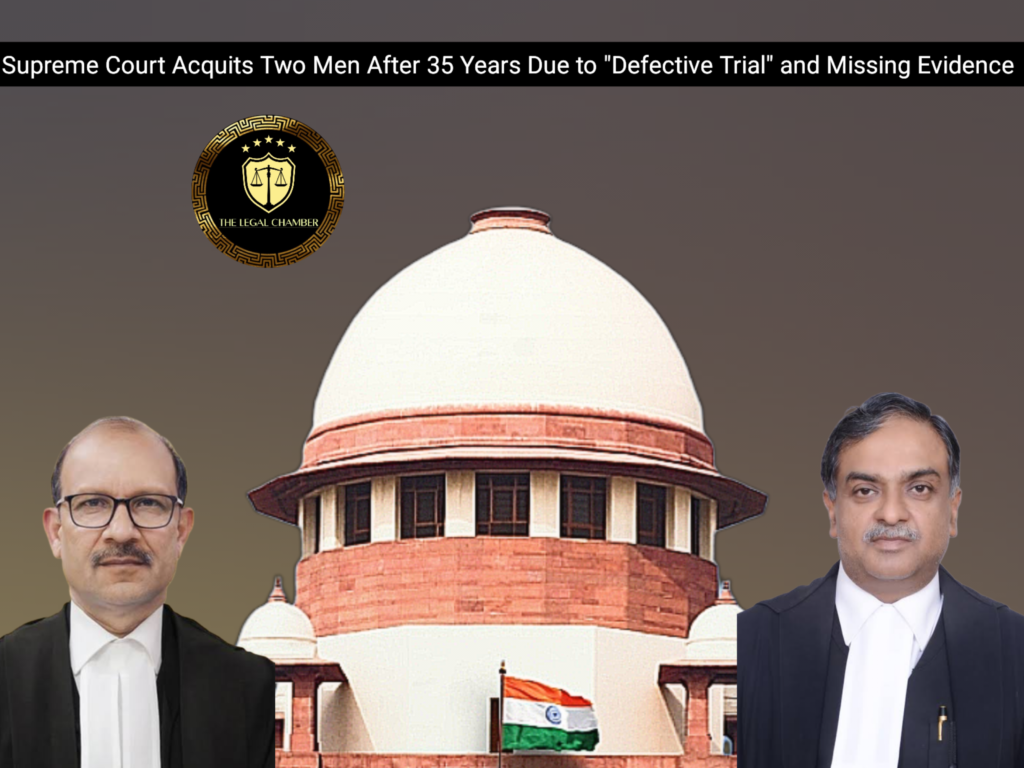
The Supreme Court held that a defective Section 313 CrPC statement, with only generic questions failing to put specific incriminating circumstances, causes grave prejudice and vitiates trial. Non-examination of a material Investigating Officer attracts adverse inference. Subsequent FIR superseding the original constitutes an embellished statement under Section 161 CrPC. Defence witnesses carry equal evidentiary value to prosecution witnesses.
Facts Of The Case:
On 11th May 1990, Gajendra Prasad Gupta was assaulted and fatally injured while returning from a village fair. His father, Rameshwar Sahu, initially gave a Fardbeyan on 12th May 1990 before ASI R. Paswan, which was treated as FIR. This statement described an altercation at the sweet stall and a subsequent attack by three unidentified persons, but did not name any assailant. The next day, the informant submitted a written report to Mandar Police Station alleging that his nephews, Suresh Sahu and Aditya Sahu, along with five to six unknown persons, had attacked Gajendra due to pending litigation over employment. He claimed his son shouted “leave me Aditya, leave me Suresh” during the assault. A second FIR was registered based on this report. The prosecution examined six witnesses, including the informant and the deceased’s sisters, who introduced an oral dying declaration. The investigating officer who recorded both FIRs was never examined. The defence examined two witnesses named in the subsequent FIR, who stated the appellants were not present. The trial court convicted the appellants under Section 302/149 IPC, and the High Court modified the conviction to Section 302/34 IPC. The appellants had remained in custody since surrendering on 1st May 2023.
Procedural History:
The appellants were tried before the 3rd Additional Judicial Commissioner, Ranchi, in Sessions Trial No. 128 of 1991. On 30th August 1994, the trial court convicted them under Sections 120B, 302, and 302/149 IPC and sentenced them to imprisonment for life. Aggrieved, the appellants preferred Criminal Appeal (DB) No. 150 of 1994 before the Jharkhand High Court. During the pendency of the appeal, their sentences were suspended and they were released on bail. On 10th February 2023, the High Court dismissed the appeal, modifying the conviction to one under Section 302/34 IPC and imposing a fine of Rs. 2,000. The appellants surrendered on 1st May 2023 and remained in custody. Thereafter, they approached the Supreme Court by way of special leave petition, challenging the concurrent findings of conviction. On 27th November 2025, the Supreme Court allowed the appeal, set aside the impugned judgment, and acquitted the appellants of all charges, directing their immediate release.
READ ALSO:Political Patronage, Hostile Witnesses, and Fair Trial: Supreme Court Declines to Cancel Bail in High-Profile Murder Case
Court Observation:
The Supreme Court observed that the examination of the accused under Section 313 CrPC was highly defective, as only three generic questions were put to each appellant without specifically articulating any of the incriminating circumstances appearing in the prosecution evidence. The Court held that this mechanical recording caused grave prejudice and vitiated the trial, and although such a defect could ordinarily be cured by remand, the passage of over 35 years since the incident rendered that course futile. The Court further observed that the High Court erred in discarding the Fardbeyan dated 12th May 1990 as the actual First Information Report, noting that the subsequent written report dated 13th May 1990 was merely a statement under Section 161 CrPC containing belated embellishments. The non-examination of the Investigating Officer, who recorded both reports, was held to be a deliberate withholding of a material witness, attracting an adverse inference against the prosecution. The Court observed that the informant’s testimony was unreliable, as he failed to identify his own nephews as assailants and systematically improved his version through multiple statements. Regarding the oral dying declaration, the Court observed that the deceased had sustained grievous cranio-cerebral injuries, including crack fractures and subdural blood clots, rendering it impossible for him to have been in a position to speak. The Court further observed that the defence witnesses, who were named as eye-witnesses in the subsequent FIR, carried equal evidentiary value to prosecution witnesses, and their categorical statement that the appellants were not present at the scene was unjustifiably discarded by the courts below.
Final Decision & Judgement:
The Supreme Court allowed the appeal, setting aside the impugned judgment dated 10th February 2023 passed by the High Court of Jharkhand and the trial court’s judgment dated 30th August 1994 with the consequent order of sentence. The Court acquitted the appellants, Suresh Sahu and Aditya Prasad Sahu, of all charges, holding that the prosecution had miserably failed to fasten guilt upon them due to total lack of credible evidence. The Court directed that the appellants, who were in custody since surrendering on 1st May 2023, shall be released forthwith unless wanted in any other case. All pending applications were disposed of. The judgment was delivered on 27th November 2025 by a division bench comprising Justice Vikram Nath and Justice Sandeep Mehta, with Justice Mehta authoring the opinion.
Case Details:
Case Title: Suresh Sahu & Another v. The State of Bihar
Citation: 2025 INSC 1382
Criminal Appeal No.: 305 of 2024
Date of Judgment: 27th November 2025
Judges/Justice Name: Justice Vikram Nath and Justice Sandeep Mehta
Download The Judgement Here