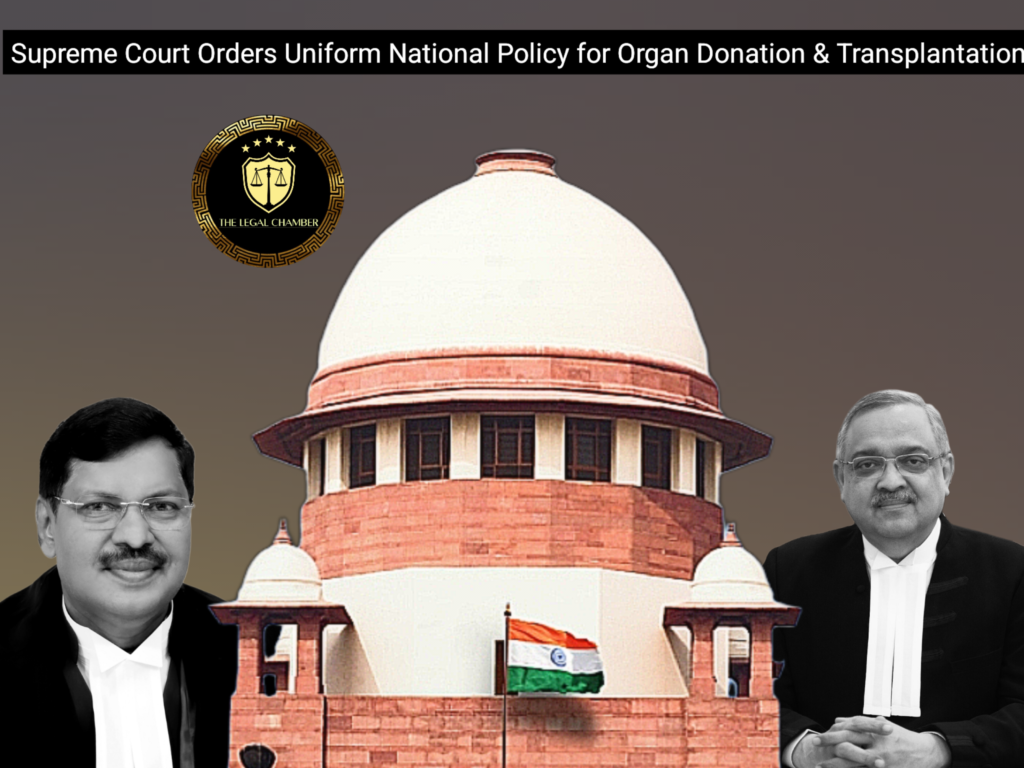
Facts Of The Case:
The Writ Petition was filed by the Indian Society of Organ Transplantation, highlighting systemic deficiencies in India’s organ donation and transplantation ecosystem. The petitioner argued that the lack of uniform adoption of the Transplantation of Human Organs (Amendment) Act, 2011, and the Transplantation of Human Organs and Tissues Rules, 2014, by certain states like Andhra Pradesh, Karnataka, Telangana, and Manipur, hindered a cohesive national policy. It was further submitted that the absence of State Organ and Tissue Transplant Organizations (SOTTOs) in Meghalaya, Nagaland, and several Union Territories severely impeded transplant procedures. The petition raised critical issues including the acute shortage of donations, the need for a national swap transplantation policy under Section 9(3A) of the Act, the lack of certified transplant hospitals in many regions, and discriminatory, state-varying organ allocation criteria. It also emphasized the necessity of amating birth/death registration forms to include brain-stem death certification and the urgent requirement for a national policy to protect and ensure follow-up care for live donors, preventing their exploitation post-surgery.
Procedural History:
The procedural history of this case is rooted in the Supreme Court’s original jurisdiction under Article 32 of the Constitution. The Indian Society of Organ Transplantation filed Writ Petition (Civil) No. 39 of 2025 directly before the Supreme Court, bypassing lower courts, to seek constitutional remedies for systemic failures in the national organ transplant framework. The Court treated the petition as a public interest litigation. During the hearing, the bench, comprising Chief Justice B.R. Gavai and Justice K. Vinod Chandran, heard extensive submissions from the petitioner’s senior counsel and received collaborative assistance from the Union of India, represented by the Solicitor General and Additional Solicitor General, who did not treat the matter as adversarial. The Court, after considering the submissions and prior affidavits from the government, issued a series of binding directions and requests to the central and state governments. It subsequently listed the matter for further monitoring after six months, preferably before a bench including Justice K. Vinod Chandran.
READ ALSO:Supreme Court: Decree for Specific Performance Does Not Create Title, So Assignment Deed Need Not Be Registered
Court Observation:
The Court made significant observations on the critical gaps in India’s organ transplantation system. It noted with concern the failure of several states to adopt the crucial 2011 Amendment and the 2014 Rules, which severely impeded the creation of a uniform national policy and grid, directly reducing transplant opportunities. The bench highlighted the complete absence of State Organ and Tissue Transplant Organizations (SOTTOs) in certain northeastern states and union territories as a major procedural barrier. It concurred with the Kerala High Court’s view in Moideen vs. State of Kerala, emphasizing that the life and health of a live donor are as precious as that of the recipient and must be protected from exploitation. The Court also observed that the lack of a national policy for swap transplantation and varying state-level allocation criteria allowed for “gaming of the system,” leading to impermissible discrimination based on gender, class, and region, which undermined the substantive right to health. It commended the collaborative, non-adversarial approach taken by the Union of India in addressing these systemic issues.
Final Decision & Judgement:
In its final decision, the Supreme Court issued a series of binding directions to establish a uniform and equitable national framework for organ transplantation. It directed the Union of India to personally monitor and persuade specific states to adopt the 2011 Amendment and 2014 Rules. The Court mandated the creation of State Organ and Tissue Transplant Organizations (SOTTOs) in states and union territories lacking them. It further directed the National Organ and Tissue Transplant Organization (NOTTO) to formulate, in consultation with all states, a uniform national policy for organ allocation and swap transplantation, alongside a five-year plan to develop transplantation facilities in underserved regions. The Court also ordered the consideration of amendments to birth and death registration forms to include brain-stem death certification and options for organ donation. Crucially, it directed the creation of guidelines for the welfare and follow-up care of live donors to prevent commercialization and exploitation. All states were ordered to ensure data reporting to the national registry, with strict action against non-compliant hospitals. The matter was listed for review after six months.
Case Details:
Case Title: INDIAN SOCIETY OF ORGAN TRANSPLANTATION  VERSUS UNION OF INDIA & ORS.
Citation: WRIT PETITION (CIVIL) NO. 39 OF 2025
Date of Judgement: 19th NOVEMBER, 2025
Judges/Justices: Justice B.R. GAVAI  & Justice K. VINOD CHANDRAN
Download The Judgement Here