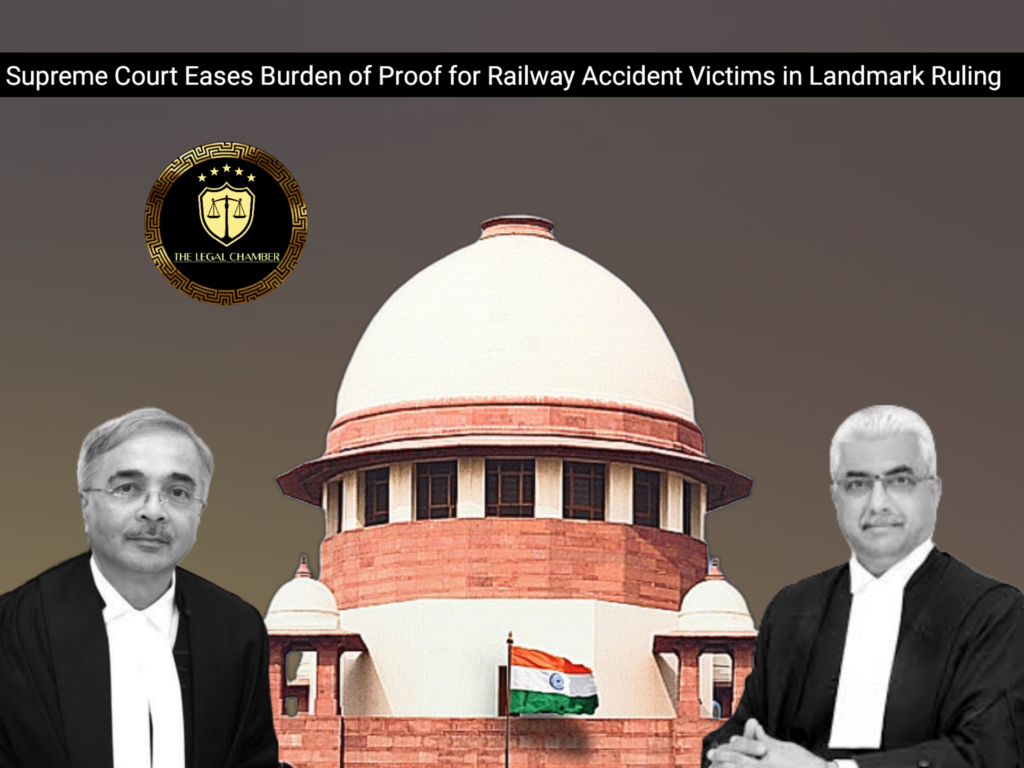
In this judgment, the Supreme Court clarified the burden of proof in railway accident compensation claims under Section 124-A of the Railways Act, 1989. The Court held that the initial burden on claimants can be discharged by affidavit and verified ticket records, shifting the onus to the Railways. Mere absence of a ticket or seizure memo does not defeat a legitimate claim, as the statutory regime is a welfare-oriented, no-fault liability system based on preponderance of probabilities.
Facts Of The Case:
The case arose from the death of Sanjesh Kumar Yagnik on 19 May 2017. He was allegedly travelling from Indore to Ujjain by the Ranthambore Express (Train No. 12465) when, due to overcrowding, he was pushed from the moving train near Ujjain, sustaining fatal head injuries. The police registered an inquest and closed it as an accidental death. His widow and minor son filed a claim for compensation before the Railway Claims Tribunal in Bhopal. The Tribunal dismissed the petition, concluding the appellants failed to prove the deceased was a bonafide passenger as no physical ticket was recovered from his person or belongings, and the photocopy submitted lacked a seizure memo. The Madhya Pradesh High Court affirmed this dismissal on the same ground, despite accepting the incident as an “untoward incident” under the Railways Act. In appeal, the Supreme Court considered the claimants’ affidavit and a key Divisional Railway Manager report dated 23 February 2019, which verified that a ticket for the relevant journey was indeed issued from Indore station on the date of the accident, as part of the police documents. The legal dispute centered on whether this evidence was sufficient to discharge the initial burden of proving the deceased was a passenger, shifting the onus to the Railways.
Procedural History:
The claimants, the widow and minor son of the deceased Sanjesh Kumar Yagnik, initiated proceedings by filing Claim Case No. OA-IIU/BPL/96/2019 before the Railway Claims Tribunal, Bhopal, seeking compensation under the Railways Act. The Tribunal, by its judgment dated 16.01.2023, dismissed the claim petition, holding that the appellants had failed to discharge the burden of proving the deceased was a bonafide passenger, primarily due to the non-recovery of a physical ticket. Aggrieved, the appellants preferred Miscellaneous Appeal No. 3451 of 2023 before the High Court of Madhya Pradesh at Jabalpur. The High Court, in its order dated 15.05.2024, concurred with the Tribunal’s factual finding on the lack of proof of a valid ticket and, despite recognizing the incident as an “untoward incident,” dismissed the appeal. The appellants then approached the Supreme Court under Article 136 by way of a Special Leave Petition, which was granted, leading to the present Civil Appeal. The Supreme Court, by its judgment dated 08.10.2025, allowed the appeal, set aside the orders of the Tribunal and the High Court, and awarded compensation to the appellants.
READ ALSO:Merely Producing a Licence is Not Collusion, Rules Supreme Court, Protecting Owners from Insurer’s Recovery
Court Observation:
The Supreme Court made significant observations clarifying the welfare-centric interpretation of the Railways Act. It held that proceedings under Section 124-A are not criminal trials requiring proof beyond reasonable doubt, but are governed by the principle of preponderance of probability. The Court observed that the initial burden on claimants can be discharged by filing an affidavit and presenting official records, such as the Divisional Railway Manager’s report verifying ticket issuance. Once this prima facie foundation is laid, the burden shifts to the Railways. Critically, the Court ruled that the mere absence of a physical ticket or a formal seizure memo, or the non-examination of an investigating officer, cannot by itself negate a claim of bonafide travel when other credible evidence substantiates it. The Court emphasized that a hyper-technical approach would frustrate the statute’s humanitarian object, and that verified official records of a ticket constitute sufficient prima facie proof to shift the evidentiary burden onto the Railway Administration.
Final Decision & Judgement:
The Supreme Court allowed the appeal, setting aside the concurrent orders of the Railway Claims Tribunal and the High Court. It held that the appellants had successfully discharged their initial burden of proving the deceased was a bonafide passenger through the affidavit of the widow and the official Divisional Railway Manager’s report verifying the issuance of the relevant journey ticket. Consequently, the evidentiary burden had shifted to the Railways, which failed to rebut the presumption. The Court awarded compensation of ₹8,00,000 to the appellants, directing the respondents to pay the sum within eight weeks, with an interest stipulation of 6% per annum in case of default.
Case Details:
Case Title: RAJNI AND ANOTHER v. UNION OF INDIA AND ANOTHER
Civil Appeal No.:  (Arising from Special Leave Petition (C) No. 19549 of 2024)
Date of Judgment: October 08, 2025
Judges/Justice Name: Justice ARAVIND KUMAR and Justice N.V. ANJARIA
Download The Judgement Here