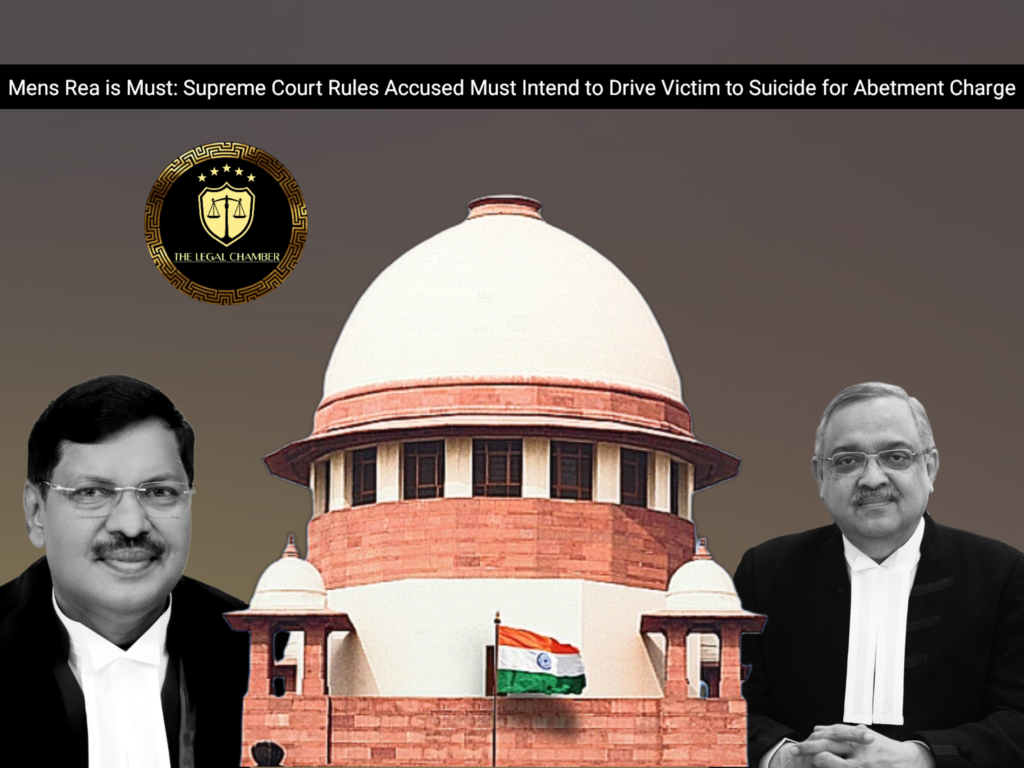
The Supreme Court reiterated that to establish abetment of suicide under Section 306 IPC, there must be clear evidence of mens rea and a proximate act of instigation by the accused, which directly led the deceased to commit suicide. Mere allegations of harassment, without positive action intended to push the victim toward suicide, are insufficient to sustain the charge. The absence of a live link between the alleged acts and the suicide warranted quashing of the FIR.
Facts Of The Case:
A seven-term independent Member of Parliament committed suicide on 22 February 2021, leaving behind a suicide note. In the note, he named several officials from the administration and police of Dadra and Nagar Haveli, accusing them of conspiring to defame, degrade, and demean him to end his political career and social standing, which he claimed drove him to take his own life. The allegations included public humiliation, such as not being invited to official functions, disrespecting his parliamentary privileges, circulating defamatory material, and attempting to extort money and forcibly take over a college trust he managed. Based on the suicide note, an FIR was registered against the named individuals. The accused parties filed petitions in the Bombay High Court to quash the FIR, arguing the allegations did not constitute abetment to suicide. The High Court allowed the petitions and quashed the proceedings, a decision that was challenged by the deceased’s son before the Supreme Court.
Procedural History:
The procedural history began with the registration of an FIR based on a suicide note left by a deceased Member of Parliament. The accused, named in the note, filed petitions under Section 482 of the Code of Criminal Procedure, 1973 before the Bombay High Court, seeking to quash the FIR. The High Court, by a common order, allowed these petitions and quashed the proceedings, finding the allegations did not constitute the offense of abetment to suicide. Aggrieved by this order, the appellant, the son of the deceased, filed the present criminal appeals before the Supreme Court of India, challenging the High Court’s decision to quash the FIR. The Supreme Court ultimately dismissed the appeals, upholding the High Court’s order.
READ ALSO:Supreme Court Slams Differential Pay, Upholds Fair Value for Fruit Trees on Acquired Land
Court Observation:
The Court observed that to constitute abetment of suicide under Section 306 IPC, there must be a clear manifestation of mens rea and a proximate, positive act of instigation or intentional aid by the accused, which directly leads the deceased to commit suicide. It emphasized that mere allegations of continuous harassment, without a “live link” or a last straw incident proximate to the time of death that demonstrates a conscious intention to push the victim towards suicide, are insufficient to sustain the charge. The Court found the suicide note, introduced belatedly and containing new allegations not previously raised before the Parliamentary Committee of Privileges, to be unreliable. It concluded that the actions complained of, including alleged disrespect to parliamentary protocol, did not amount to instigation and that no case for abetment was made out from the FIR.
Final Decision & Judgement:
The Supreme Court dismissed the appeals and upheld the Bombay High Court’s judgment quashing the FIR. The Court concluded that the allegations, even if accepted as true, did not disclose the essential ingredients of the offense under Section 306 of the IPC. It found no evidence of mens rea or a proximate, instigating act by the accused that could be deemed to have abetted the suicide. The suicide note was deemed suspect due to its belated introduction and the fact that its grave allegations of extortion and conspiracy were never previously raised before the Parliamentary Committee of Privileges. Consequently, the Court affirmed that no case for trial was made out.
Case Details:
Case Title: Abhinav Mohan Delkar vs. The State of Maharashtra & Ors.
Citation: 2025 INSC 990
Criminal Appeal No(s).: Criminal Appeal Nos. 2177-2185 of 2024
Date of Judgement: August 18, 2025
Judges/Justice Name: Justice B.R. Gavai  and Justice K. Vinod Chandran
Download The Judgement Here