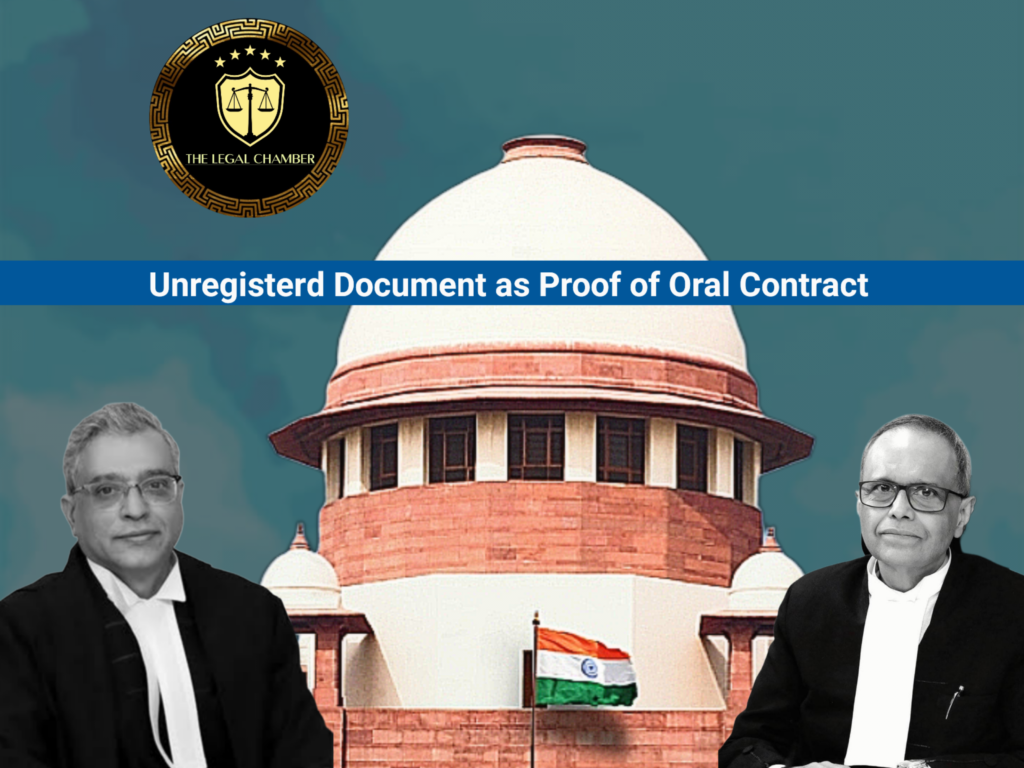
The Supreme Court ruled that an unregistered and unstamped sale agreement (dated 01.01.2000) could be admitted as evidence under the proviso to Section 49 of the Registration Act, 1908, in a specific performance suit. The Court clarified that such documents are permissible to prove collateral transactions or oral agreements, even if inadmissible for transferring title. It overturned the High Court’s rejection, emphasizing that admissibility for limited purposes does not require stamping or registration. The judgment reaffirmed the precedent in S. Kaladevi v. V.R. Somasundaram (2010) 5 SCC 401, allowing unregistered documents as evidence in suits for specific performance or collateral claims. No costs were awarded.
Facts Of The Case:
The dispute arose from an agreement to sell dated 01.01.2000, where the respondent (since deceased, represented by LRs) agreed to sell property to the appellant, Muruganandam, for a partial payment of ₹5,000. The appellant claimed possession and further payments (totaling ₹10,000 at ₹550/cent) but alleged the respondent avoided executing the sale deed. This led the appellant to file O.S. No. 78 of 2012 before the District Munsiff Court, Madurantakam, seeking specific performance and a permanent injunction. During proceedings, the appellant filed I.A. No. 1397 of 2014 under Order 7 Rule 14(3), CPC, to submit the original 01.01.2000 agreement (previously misplaced but referenced in the plaint via photocopy).
The Trial Court (21.04.2015) and Madras High Court (26.02.2021) rejected the application, citing the document’s lack of stamping and registration under Section 35 of the Stamp Act, 1899, and Section 17 of the Registration Act, 1908. The appellant appealed to the Supreme Court (Civil Appeal No. 6543 of 2025), arguing the document was admissible under the proviso to Section 49 of the Registration Act to prove the oral agreement. The Supreme Court (08.05.2025) allowed the appeal, permitting the document’s admission solely as evidence of the contract, not for transferring title, and remanded the case for trial.
Procedural History:
The case began with the appellant filing O.S. No. 78 of 2012 before the District Munsiff Court, Madurantakam, seeking specific performance of an oral agreement to sell (backed by an unregistered document dated 01.01.2000) and a permanent injunction. During the trial, the appellant filed I.A. No. 1397 of 2014 under Order 7 Rule 14(3), CPC, to submit the original agreement, which had been misplaced earlier. The Trial Court (21.04.2015) dismissed the application, holding the document inadmissible for being unstamped and unregistered under the Indian Stamp Act, 1899 and Registration Act, 1908. The appellant then filed CRP.PD No. 2828 of 2015 before the Madras High Court, which upheld the Trial Court’s order (26.02.2021).
On appeal, the Supreme Court (Civil Appeal No. 6543 of 2025, arising from SLP(C) No. 10893 of 2021) reversed the lower courts’ decisions (08.05.2025). It ruled that the document could be admitted under the proviso to Section 49 of the Registration Act as evidence of the collateral contract in a specific performance suit, clarifying that admissibility for limited purposes does not require stamping or registration. The case was remanded for trial, with no costs imposed.
Court Observation:
The Supreme Court made several pivotal observations while overturning the lower courts’ decisions. It emphasized that the proviso to Section 49 of the Registration Act, 1908 expressly permits unregistered documents to be admitted as evidence in specific performance suits or to prove collateral transactions, even if they cannot confer title. The Bench clarified that the absence of stamping or registration does not bar a document’s admissibility for these limited purposes, provided it is not used to directly affect immovable property rights. Critically, the Court distinguished between a document’s admissibility (which was allowed) and its legal weight (left for the Trial Court to assess). It relied on its precedent in S. Kaladevi v. V.R. Somasundaram (2010) to reaffirm that unregistered sale agreements can evidence oral contracts. The judgment underscored that technical defects (like non-registration) should not defeat substantive justice in suits for specific performance, where the focus is on proving the existence of a contract. However, the Court expressly reserved all rights of the respondents to challenge the document’s validity during trial.
Final Decision & Judgement:
The Supreme Court allowed the appeal and set aside the orders of the Madras High Court and Trial Court, ruling that the unregistered and unstamped agreement dated 01.01.2000 could be admitted as evidence under the proviso to Section 49 of the Registration Act, 1908. The Court clarified that while the document could not be used to establish title or directly affect immovable property rights, it was admissible for two specific purposes: (1) as evidence of the contract in the specific performance suit, and (2) as proof of collateral transactions not requiring registration.
The Bench emphasized that this limited admissibility would enable the appellant to substantiate his claim of an oral agreement while preserving the respondent’s right to contest the document’s validity during trial. The case was remanded to the Trial Court for fresh consideration with directions to examine the document’s evidentiary value in accordance with the judgment. No costs were awarded, and all pending applications, if any, stood disposed of. The judgment reaffirmed the principle that technical deficiencies in documentation should not automatically defeat claims in equity, particularly in suits for specific performance where the existence of an agreement is paramount.
Case Details:
Case Title: Muruganandam vs. Muniyandi (D) Thr. LRs

Citation: 2025 INSC 652

Appeal Number: Civil Appeal No. 6543 of 2025 (Arising out of SLP (C) No. 10893 of 2021)

Date of Judgment: May 8, 2025

Bench: Justice Pamidighantam Sri Narasimha & Justice Joymalya Bagchi
Download The Judgement Here